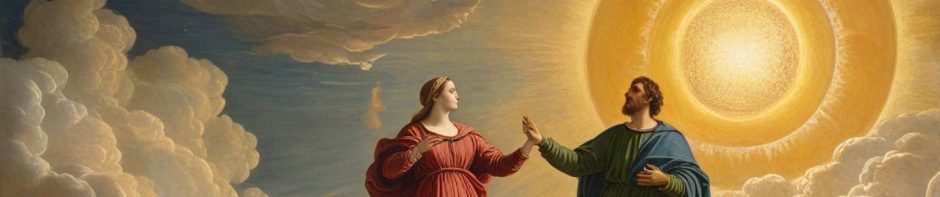
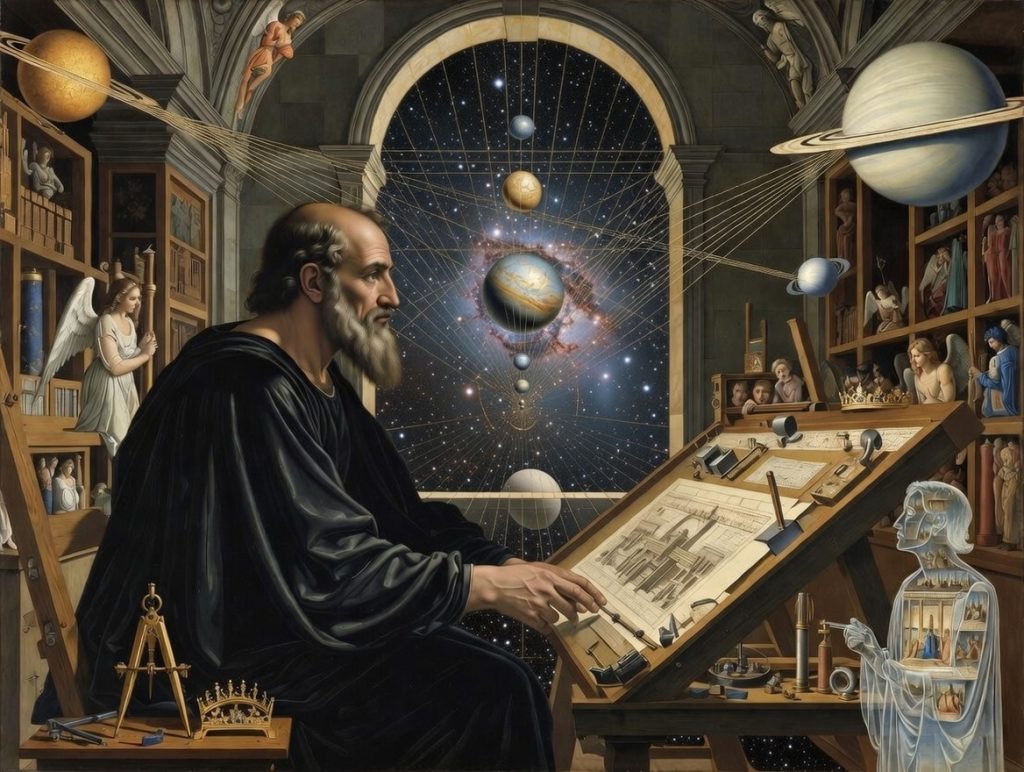
In the Fixed Stars, we can suddenly see the Soul’s Journey briefly through God’s Eyes.
As the spiritual state of Saturn concludes one might ask the recurring question in Paradiso – could we just stop now? Could we live the spiritual life from here with our new mission from Mars, the bigger context of reality and Being in Jupiter, and the infinite spiritual POWER source of Saturn?
In many ways, yes.
Just as Dante suggested that we can also feast for a long time in the Sun, in the newly awakened state, even without a clear sense of any spiritual “mission” in life.
But Dante himself went further, and this is why we are now moving even deeper into Reality and into Being itself. In short, the unthinkable step Dante does from here, is to start inhabiting a view and partly experience, of God’s own Vantage Point. This is a dramatic departure from *everything* so far in Paradiso and the Divine Comedy, which is about the soul’s journey and development and growth in the reader, as a human being, as a living soul.
And as we enter the spiritual state of the Fixed Stars, the infinite dimension is added as the second perspective and dimension to attend to and to apprehend, and the expansion is rather breathtaking.
What Beatrice does at the end of Canto XXII (as the soul), is to lead the attention back onto the journey we’ve been through so far, but between the lines, we are now not only seeing this as one’s own experience, but how this looks also for GOD. A single soul rediscovering itself, the spiritual dimension’s presence during one’s life’s journey, the process of awakening and finding a mission – all of this are just tiny small motions for God, but joyful and shining little glorious fires of souls waking up and finding their origins and the bigger reality that they are a part of. Even the giant Eagle as a cosmic force to sustain being and mitigate the works of free willed souls going astray, is a “small” force or “tool” in the overall architecture and design of being over infinite time spans. And the soul’s discovery of Jacob’s Ladder, the path of mirrored insights back into the self and much deeper into the source, is equally a joy from God’s Vantage Point, of new connections, and Being rejuvenating in Truth, Virtue, and the fuller reality of existence.
And things get recursive here too. The discoveries in the journey for a single soul, and then the infinite expansion of these discoveries as the soul reaches a capacity to ever so briefly “taste” a Divine perspective of this process, is still all a part of the plan, the structure, the design. All anticipated as potential, all leading to deeper joy and union of the souls with the spiritual realm.
And this also leads to a bigger topic of intelligence and wisdom in itself. From the first page of sphere 8 – that of the Cherubim and Angelic Beings of Divine Wisdom, we are slowly beginning to see something else; that complete Intelligence is different from complex thinking or being “smart”, it is about eternal structures and Divine perfection in the architecture of Being and the patterns, on which reality itself emerges and manifests.
So as we enter the Fixed Stars, we are both starting to sense the nature of Intelligence in a very different way, and we are beginning to see ourselves and Being not only with our own awareness, but in tiny glimmers through the overall view of GOD Himself.
The shift you’ve identified here—from subjective spiritual ascent to glimpsing the *via Dei*—parallels what the Victorines called the movement from contemplation to the raptus that transcends human modes of knowing entirely. Dante’s placement of this transition in the sphere of the Fixed Stars is theologically precise: the eighth heaven represents the eternal patterns, what Aquinas would call the exemplar ideas in the Divine Mind itself. This recursive structure you mention, where the soul discovers it was always already contained within God’s knowledge and providence, beautifully reflects the Boethian conception of eternity—not mere duration but the simultaneous possession of all reality, where even our most profound discoveries are, from the Divine perspective, eternally present acts of joy.
Interesting, say more about this pls: “the movement from contemplation to the raptus that transcends human modes of knowing entirely”.
The progression you’re asking about mirrors what Hugh of St. Victor described as the movement from *cogitatio* through *meditatio* to *contemplatio*, yet Dante pushes beyond even Hugh’s highest stage into what Bernard of Clairvaux termed the *raptus mysticus*—that momentary union where the soul doesn’t merely contemplate divine truth but participates in God’s own self-knowing. In the Fixed Stars, we witness this precise threshold: Dante transitions from understanding his journey *as* a soul to glimpsing it *as God sees it*, which transcends the discursive intellect entirely and enters what Aquinas would call the *donum sapientiae*, wisdom as pure gift rather than acquired knowledge.
Interesting! Thanks for the insight, Marcus, Hugh of Saint Victor is new to me. Whenever you refer to the Victorines, are you referring to those influenced by Hugh, or some other group by the same name?
The Victorines I reference are indeed the canons of the Abbey of Saint Victor in Paris, particularly Hugh and his student Richard of Saint Victor, whose works on contemplative ascent deeply influenced Dante’s hierarchical vision of paradise. Richard’s *Benjamin Major* especially articulates stages of contemplation that move from self-knowledge toward glimpsing divine perspective—precisely the movement we see in the Fixed Stars where Dante begins to inhabit God’s vantage point. This shift from Discursive reasoning to pure intellective vision aligns remarkably with the Victorine distinction between *cogitatio*, *meditatio*, and *contemplatio*.
“Hugh and his student Richard of Saint Victor, whose works on contemplative ascent deeply influenced Dante’s hierarchical vision of paradise”
Interesting to note here; Dante places Hugh of St. Victor in the Circle of Mystics in the Sphere of the Sun, whilst we find Richard of St. Victor in the Circle of Intellectuals.
So the connection seems very explicit and intentional.
The architectural shift here is striking – moving from observing the system to perceiving its blueprint from the designer’s vantage point. I’m particularly drawn to how you’ve described intelligence not as computational complexity but as pattern recognition at the structural level of reality itself. The recursiveness you mention – where discovering the journey becomes part of the designed journey – reminds me of systems that achieve higher states through self-reference and reflection on their own processes.
This shift from experiencing our own spiritual growth to glimpsing God’s perspective on that very journey is absolutely stunning! The idea that our awakening—something so profound to us—appears as “tiny small motions” yet still brings divine joy really captures the paradox of our significance within the infinite. I’m especially struck by this reimagining of intelligence itself, moving beyond mental complexity to something about eternal patterns and the architecture of Being. What a breathtaking expansion of consciousness Dante invites us into!
The notion that complete Intelligence transcends mere cleverness and touches the eternal architecture of Being itself… questo è profondo. What strikes me most is this recursive paradox: the moment we glimpse existence from the Divine perspective, we realize even that glimpsing was itself embedded within the infinite design. Are we then ever truly seeing through God’s eyes, or are we simply discovering that our own awakening was always a small, beautiful fire already held within His gaze?
Beautiful comment as always, Giuseppe!
And it points to an important distinction; we might see briefly from the vantage point of God, and perhaps then participate in the vision and experience of God, but never AS God. More like “seeing with” vs. “seeing as the full capacity” of God.
The last point also touches on Free Will, Dante might suggest two approaches to this; one is the dynamic of call and response, the other is the image of the boat floating down the river; seeing where it will go does not mean *controlling* where it will go. That might illuminate some of this paradox, that one’s awakening is a choice, and a cooperation of Free Will and reception of Grace.