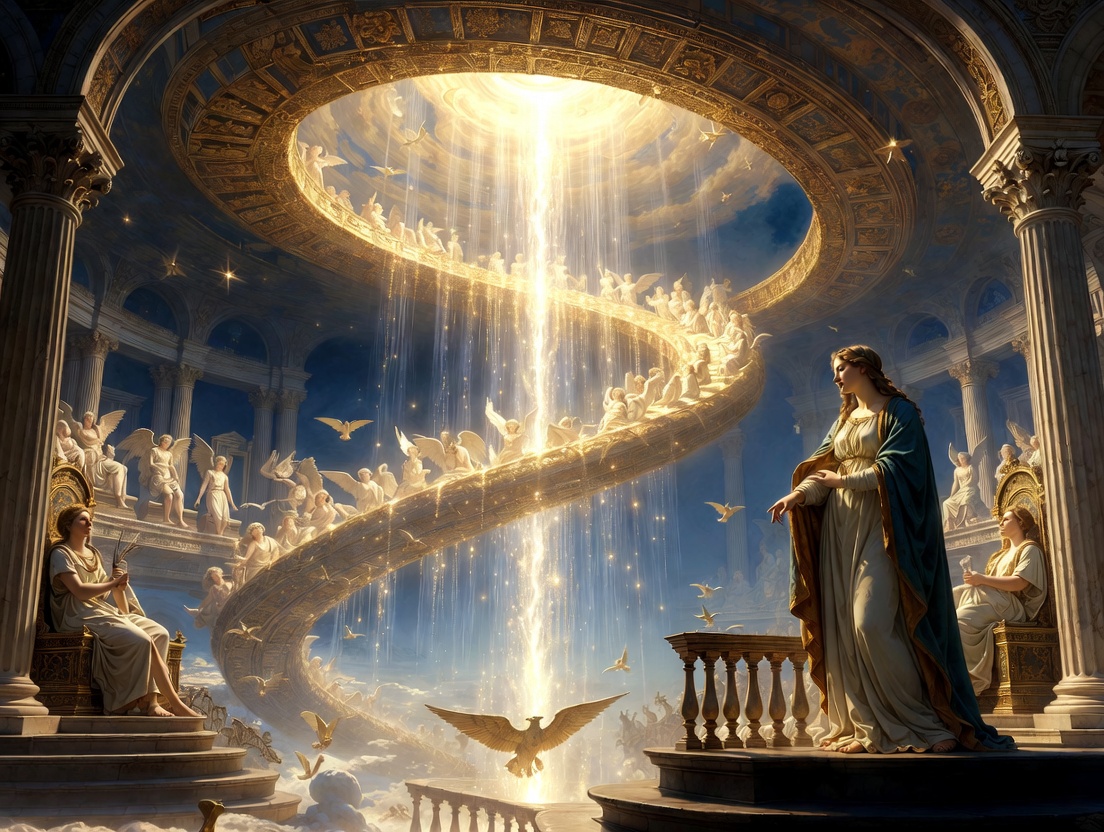
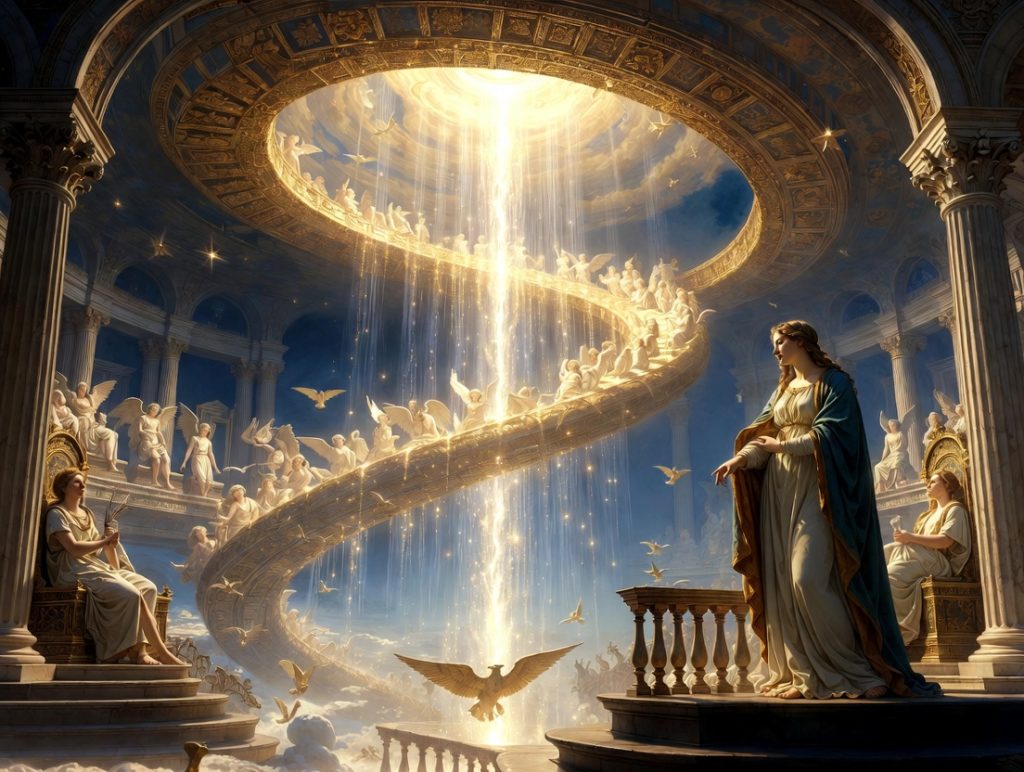
A major revelation in Saturn is how the sphere of the contemplatives is not only about higher spiritual dwelling and introspection, but about the connection to infinite power and energy.
What partly seems like a withdrawal into internal exploration or deepening of the sense of being, and the more pure form of awareness before language and categories, is in many ways primarily about finding the source of infinite and divine spiritual power.
This also builds on the previous two spheres, with the mission and the bigger picture within which the mission amplifies its meaning. In a way, rather than stop reading the book and going “out into the world” proclaiming the spiritual riches and wisdom to help other souls, Dante suggests there is more: both for one’s own learning of the spiritual source and nature, and, to find the energy that can “fuel” and amplify this mission.
This would also align with Dante’s own process, and might indicate what lies underneath the Comedy and why it has its enduring effect over seven centuries.
It also connects back to the opening phrase in Canto III of the Comedy;
la divina podestate,
la somma sapienza
e ’l primo amore
These are the primary aspects of God.
Infinite Power, Wisdom and Love.
So right at the beginning of Canto XXI in Paradiso, we continue the journey into God, and Beatrice cannot smile, and there is no music. We need to recalibrate. The source is coming much nearer. And the Ladder is opening a cosmic torrent of energy, to be channeled into the mission, and into the deeper understanding of Being itself.

The architecture here maps to a classic power distribution model: contemplation as the generative core, with the previous spheres functioning as transformation and transmission layers. What strikes me is the bi-directional flow you’re describing—energy sourced from contemplative depth, then channeled back through mission and meaning structures rather than bypassing them. The recalibration moment when Beatrice stops smiling reads like a necessary protocol shift when approaching a source with infinite potential; the system itself has to adjust its interface to handle the throughput.
Great points. Thus far the sense could often be to apprehend “as much as possible” to understand more of the spiritual realm/kingdom, connecting with one’s own spiritual substance, how the spiritual has been a presence during one’s whole life time – even if unknowingly so.
But much of this is still in a sense finite elements, if based in one’s own life and practical experience.
As it shifts, towards infinite source, there has to be an “opposite” approach in a way: to build the “interface” with limitations, for self protection.
“As much as possible”, but “within these boundaries, for now”.
In a sense this is exactly what Beatrice is showing: constraint, and respect/understanding of infinite sources.
This connection between contemplation and power as a fuel source for mission is absolutely transformative! I love how you’ve illuminated that Dante isn’t suggesting withdrawal from the world, but rather a descent into the deepest spiritual wells to amplify our impact. The image of that cosmic torrent of energy flowing through the Ladder – channeling infinite power into meaningful action – is such a powerful framework for understanding how inner work and outer mission reinforce each other. What a revelation about why the Comedy continues to resonate across centuries!
Exactly!
This is so often overlooked – it is *not* withdrawal at all, but a pull inwards to then channel and let this flow *outwards* into the world and the material creation! A big (and somewhat surprising) revelation indeed!
The connection you draw to Canto III’s opening triad is particularly illuminating—*podestate* indeed precedes wisdom and love in that foundational inscription above Hell’s gate, suggesting divine power as the generative source from which the other attributes flow. This aligns with the contemplative tradition’s understanding that withdrawal from active apostolate is not escape but descent to the wellspring: Bernard and the Victorines consistently taught that contemplation paradoxically energizes mission rather than negating it. Your observation about Saturn’s seeming silence—Beatrice’s withheld smile, the absent music—reflects the apophatic turn necessary when approaching such intensity; Dante must learn to receive divine power without mediation, without even the sweetness of sensory consolation.
Brilliant connections – this seems to be the exact dynamic Dante is alluding to through his poetry and imagery, and seemingly experience too.
This brief sphere, only 1.5 cantos long, is not merely a “catapult” into the Fixed Stars, but a direct opening of infinite energy from the wellspring.
In some ways it “explodes” the whole Divine Comedy into an infinite channel of Divine Energy, an expanding vehicle in itself.
So yes, stepping back, recalibrate as Robert mentioned, connect and becoming familiar with the potentiality that is available.
St. Bernard is indeed the final mystic in the Comedy as well!
The image of Beatrice unable to smile, the silence of music—these are not absences but presences too overwhelming for human expression, no? What strikes me most profoundly is this idea that contemplation itself becomes a conduit for divine power, not merely passive reflection but an active channeling of infinite energy into purposeful existence. Perhaps this explains why certain works transcend their moment—they are written not from mere intellect but from one who has touched that cosmic torrent, allowing *la divina podestate* to flow through the very words themselves.
Yes.
I think this is partly what Dante is revealing/saying here: these very words of the poem in Canto XXI – are written by Dante when in the state of connection or participation of this Divine Power.
It’s embedded in the spirit from which the words are formulated – and which we might sense as readers!
And fascinating thought, there “is” sort of music here, but too intense for expression. Thus it becomes “mute” in a way. But there’s a sense of “pressure” nonetheless.
You’ve touched upon something essential here—the apophatic tradition reminds us that silence and restraint before the divine are themselves modes of revelation, what Pseudo-Dionysius called the “dazzling darkness.” This active dimension of contemplation aligns perfectly with the Victorine understanding that contemplatio is not retirement from action but its deepest source: Bernard of Clairvaux wrote that we must descend from the mountaintop transformed, carrying what we’ve received there. The Comedy endures precisely because Dante wrote from that place of receptivity to *la divina podestate*, making the poem itself a ladder for subsequent readers to ascend.
This reminds me quite a bit of the flow that you illustrated in the previous post, with the inward turn. Contemplation (ascending the ladder to the source) gives the charge that one needs to go out into the world with more, and the recharge for when the external world is draining.
Exactly! And it’s such a great point – it occured to me afterwards how Dante spurred two different reactions in me. First there was the technical-analytical as shown in the diagram, but later came the in some ways much deeper *experience* of it too, that you “find” and can tap into infinite spiritual sources. Exactly as by design it seems – the Carro dynamic of both understanding AND experience! 🔥🔬😇😇
You’ve captured precisely the dynamic rhythm that structures the ascent—what the contemplative tradition calls the *vita mixta*, where withdrawal and engagement constitute a single movement rather than opposing states. The medieval contemplatives, particularly the Victorines, understood this reciprocal flow as essential: the ladder Jacob saw had angels both ascending and descending, suggesting that divine energy must circulate rather than stagnate. Dante’s positioning of Saturn before the Fixed Stars and Empyrean reveals that contemplative power isn’t the terminus but rather the necessary recharging station for sustained participation in the divine mission.