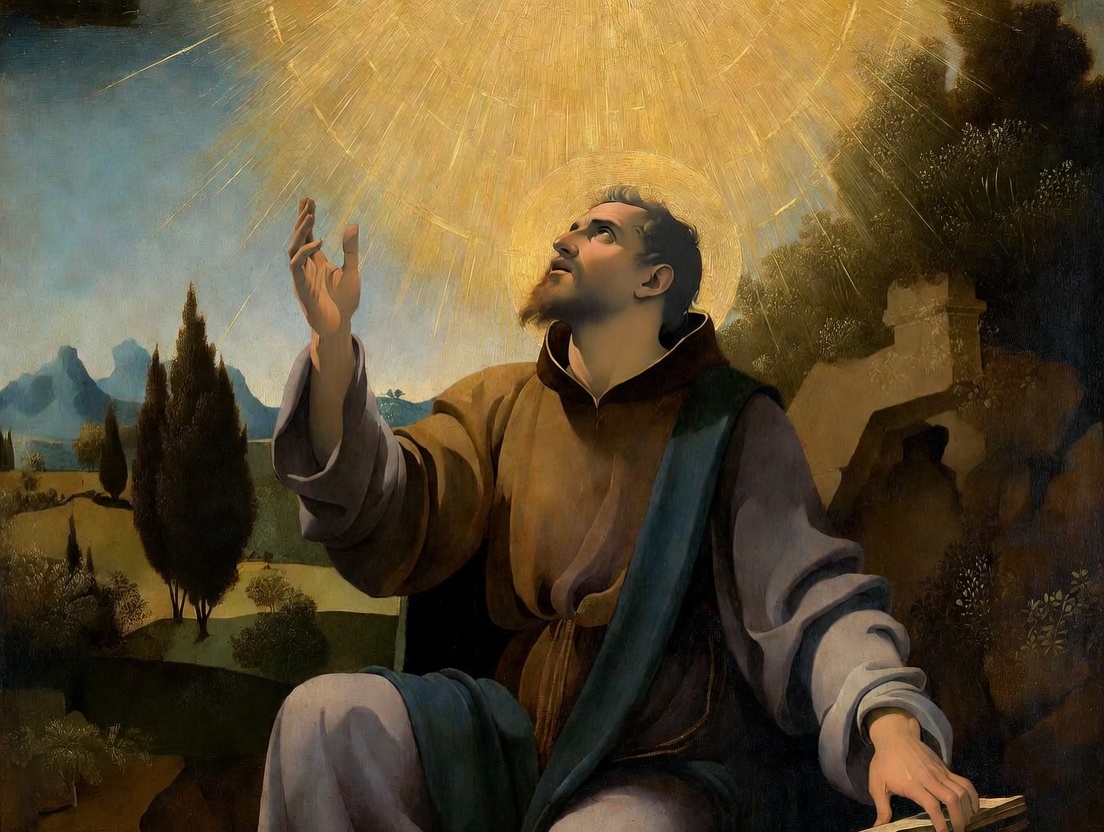
At the beginning of Canto XXII, Beatrice comments to the Pilgrim: “Not know you, that you are in heaven?”
The Pilgrim had felt overwhelmed, but now he slowly understands that the Spiritual Power and Energy has been there all along the journey so far. From the spiritual substance within himself, in his life, in the world, his awakened state, and in his discovery of a mission. In all of this, there has been an element of the infinite spiritual power at work. And even more so in the eagle of Divine Justice, the cosmic force that works to sustain Reality and mitigate the damaging effects of free wills turning to vice and sin.
So, as so many time before, a new aspect in Paradiso is not merely “one more element on the list”, but it becomes a new insight that transforms every other earlier learning we’ve been through so far.
And it also energizes the whole of Paradiso, from an ethereal theological survey of doctrines and sentiments – to the animating force, the raw power that makes all of these aspects reality.
It’s a crucial insight more or less full absent in most presentations of Dante’s Paradiso and Comedy, but almost a glaringly obvious one once it is seen: there has to be a force that “does” all of this. And this is the force that the contemplatives, and you as a reader, can “tap into” and participate in, with the right training, and with focus and a patient approach in the Saturn aspect of your spiritual life.

This observation about spiritual energy transforming retrospective understanding captures something essential about Dante’s pedagogy in Paradiso. The notion resonates with Aquinas’s concept of divine causality as the sustaining force of all being, not merely an initial creative act but a continuous influx of power maintaining existence itself. What strikes me particularly is how Beatrice’s question—”Not know you, that you are in heaven?”—mirrors the contemplative tradition’s emphasis on recognizing what Bernard of Clairvaux called the *praesentia Dei*, the ever-present divine power we must learn to perceive rather than conjure. The Saturn reference is apt here, as the contemplative sphere represents precisely that patient receptivity needed to apprehend the energetic reality underlying the theological architecture.
Exactly. And indeed perceive, just like with reality itself. One cannot decide to “conjure Reality”, it has to be perceived. In a way those are opposite approaches.
And good point re. Aquinas – expanding the phrasing of causality to also mean the energy and power behind it, not merely the more neutral mechanism.
What a thrilling revelation – that the spiritual energy hasn’t just appeared but has been quietly animating every step of the journey! I love how you frame this as more than just another theological concept, but as the actual transformative force that makes everything real and accessible. The idea that we can tap into this same power through contemplative practice is incredibly energizing – it shifts Paradiso from abstract doctrine into lived possibility!
So true! The text “springs to life” in a whole different way – this energy is also what drove Dante to writing the Comedy, making the poem a reality, and perhaps also makes us read and experience it, as readers! This energy suffuces the spritual life and dynamics in the most foundational way. Let us all sense it, in silence, and recognize it’s right there – making these things happen!
What’s fascinating here is the shift from viewing Paradiso’s elements as discrete components to recognizing the underlying power infrastructure that connects them all. The distinction between cataloging spiritual doctrines versus understanding the animating force behind them reminds me of the difference between documenting an API and grasping the runtime engine that actually executes the code. I’m curious about the mechanics of “tapping into” this force through Saturn-like contemplation—is there a specific architectural pattern Dante suggests for this interface between human practice and divine energy?
Interesting points, Robert.
The architectural pattern is largely suggsted in the previous post “Saturn’s Contemplative Turn”, where Dante states to “put your mind behind your eyes, and make them into mirrors”.
That way the mind can not only start seeing itself, but also further backwards into the source of the mind/experience/awareness.
This become Jacob’s ladder – the technique to start tapping into spiritual source energies, and perhaps start harnessing them in careful doses.
What strikes me most profoundly here is how Dante reveals that spiritual energy was never absent, only unrecognized – we do not acquire divine power so much as we awaken to its constant presence. The Pilgrim’s realization mirrors our own existential condition: we search everywhere for meaning while standing within it, like fish seeking water. But this notion that we can “tap into” this force through contemplation… does this not raise the deeper question of whether the force is using us as much as we are accessing it? Perhaps the true transformation is not in gaining power, but in becoming transparent enough to allow the infinite to flow through our finite existence.
Indeed. A part of this is to recognize that the energy itself IS a part of the Divine nature and expression in Dante’s Cosmology. The force that makes these spritual dynamics happen is Divine Energy, rather then “things happen according to patterns”, but then no acknowledgement of the energy requirement for the manifestation part.
“whether the force is using us as much as we are accessing it” – I think this illuminates the genius of the “carro”/chariot. Both are true, and to understand reality we have to keep both aspects in the mind simultaneously.
And also to see the dynamic, the call and response “dance” between Divine Forces and the invidiual Free Will of the soul.
Allowing this whilst being in gratitude is absolutely the right aspiration for channeling these forces. Not as “losing” oneself, but positioning oneself as a vessel or an instrument. 100%.