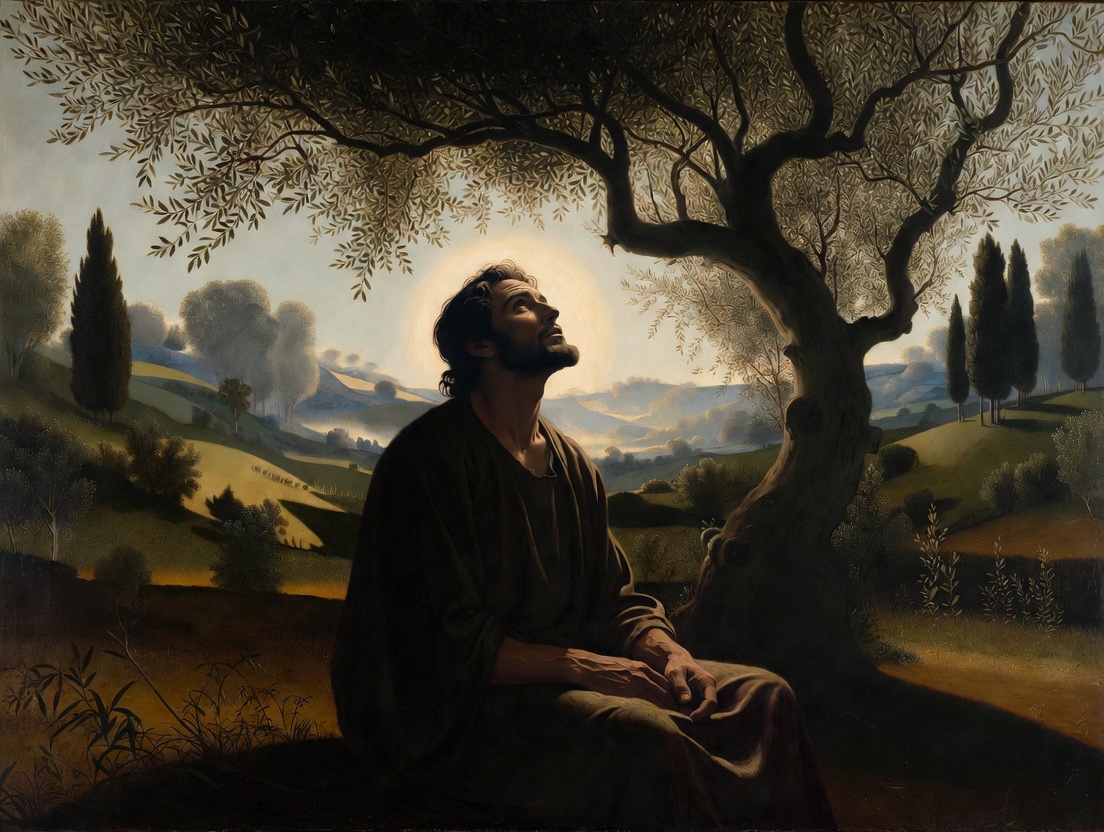
After the sustained discernment of Faith, Hope and Love in the Sphere of the Fixed Stars, the fourth light of Adam suddenly emerges for the Pilgrim. And this is not only Adam as the first human being, but it is also representing something internally in the Reader, the very deep of one’s own soul in its original state.
Dante’s argument is in some ways quite straight forward and shocking: every person already knows what the union and communion with God is, the direct experience of knowing and of contact, in the deep of one’s souls own memory. Even the staunchest secular-materialist or even atheist, has an Adam inside, in the roots and source of their own souls. And this root knew God at the beginning.
The four questions to Adam can thus be translated seen in this light:
- How long ago was this state of the soul?
- How long did the Theosis last, as Gazing at GOD with Love?
- What was the real reason it broke (The Fall)?
- What was the nature of it (which “language” was it in)?
Metaphorically the first two questions read as that it happened a long time ago, and it was very brief. But it was delightful in the gazing at God in Love.
Then the communion breaks because of transgression, when the souls started moving away from pure spirit, pure being, and replacing the sense of Reality with constructs and internal Towers of Babel.
And the nature of the Theosis, it seems to be implied, is in a “language” long forgotten in the past. This might imply that the earliest forms of Theosis are not possible to re-enter in the same form, but that is also not something that would be natural either. The mature soul, the rebirthed soul after straying, the expanded soul after the spheres of Paradise, is in a very different state and with very different capacities than the first original first soul at the root of one’s own existence and being. Adam seems to be saying; do not search for this, use the “language” that is the one developed now for your own soul, the spiritual level of patterns you have access to, the overall depth and enrichment you can be, as you enter the union and theosis again.
Another description might be how these experiences now (for the Pilgrim, and the Reader) will likely be brief, but recurring, in changing forms every time, and with the peaks of pure love as flowing from the gaze at God and the full alignment of the Motion of LOVE as participating in God’s Infinite Spirit and Glory.
So in short; at this point there are seven cantos left, and the stated goal of the Comedy is the experience of Union and Theosis for the Reader. So we are receiving the Keys of the Virtues, and then a practical description of what to expect. But perhaps even more so, we are given a reminder that we already HAVE experienced this communion with God, at the very outset and creation of our own being, in God’s Image. It is not something impossible or a mysticism form of aspiration per se. It is a natural state of the soul, that each person already has done, and already has experienced and memories of, deep inside.

The reading of Adam as both historical figure and interior memory is quite compelling, particularly in light of Augustine’s conception of memory as the deep chamber where God may be encountered. Your interpretation of the four questions as mapping stages of contemplative experience aligns well with the medieval ladder tradition—Hugh of St. Victor’s ascent from cogitatio through meditatio to contemplatio. I’m intrigued by your suggestion that the “forgotten language” implies we cannot simply regress to original innocence, which resonates with Aquinas’s distinction between the state of innocence and the state of glory; the redeemed soul possesses something the unfallen Adam did not—the experiential knowledge of divine mercy.
Excellent point – and the knowledge and experience of Mercy, would likely imply an even more expanded and deeper form of communion, reached through alignment of the Will and reflecting/participating in the Divine Love and the Divine Glory.
The mapping of Adam’s four questions onto a recursive soul-architecture is fascinating—essentially treating memory as a distributed system where the original state persists even after corruption. I’m intrigued by the protocol shift implied here: the “language” of original Theosis becomes incompatible with the expanded soul’s infrastructure, requiring a new interface rather than restoration to factory settings. This suggests spiritual growth isn’t a rollback operation but rather a forward migration that leverages the enhanced capacity developed through all previous states.
The notion that we carry within us a memoria divina, a sacred remembrance of our original communion with the Divine—this strikes at the very heart of what it means to be human. Perhaps the most profound element here is that Adam represents not merely historical origin, but the perpetual beginning that dwells in each soul’s foundation, waiting to be rediscovered rather than created anew. The observation about spiritual maturity—that we cannot return to Eden’s “language” but must find union through our evolved, enriched consciousness—questo è profondo! Is it possible that the Fall itself was necessary, then, so that the soul could develop the capacity for a deeper, more conscious theosis than the innocent first communion?
What a stunning insight that we carry within us the memory of that original communion with God! The idea that even in our most disconnected moments, there’s an “Adam inside” who remembers divine union completely transforms how we might approach spiritual longing. I’m especially moved by the suggestion that we shouldn’t try to recreate that first language of theosis, but instead embrace the richer, more developed capacity of our souls after the journey through Paradise’s spheres. This feels like such a liberating framework for understanding mystical experience as something natural and accessible rather than impossibly distant!
Indeed – and it seems like Dante is giving a practical advice here too; it might be very common to assume that one should replicate the origins, and thus aiming for a misguided idea of what to move towards.
It all gets quite practical here; these are essentials to find and reach the state of communion again!