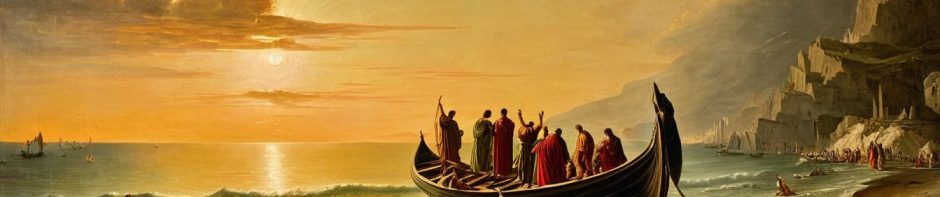
After the discovery of the Ark in the Chariot, pulled by Oxen, the Pilgrim sees more in the same image: people into front grouped in seven choirs, and his material and spiritual perceptions are again in conflict. One says “no”, the other says “Yes, they sing”.
Dinanzi parea gente; e tutta quanta,
partita in sette cori, a’ due mie’ sensi
faceva dir l’un «No», l’altro «Sì, canta».
Meaning: “In front appeared people, and all of these made, parted into seven choirs, to my two senses saying “no” and “yes, they sing”.
This seems to build directly on the foundational steps in the newly refound spiritual life. First the connection with “Gabriel”, then the steadily moving spiritual life (as in Ark and Oxen), and now the different modes or aspects of the spiritual: the seven gifts of the Holy Spirit.
What is important here is that this is not a doctrinal list of theology, but core aspects of your own awareness in terms of how you engage with Reality. These seven “choirs” represent Wisdom, Knowledge and Understanding, Council and Fortitude, and Piety and Awe.
Meaning: once you connect and participate in the spiritual life within you, you will also discover how this is present and a part of your active mind with understanding, knowledge and wisdom, of how you act in the world with council and fortitude, and even bigger how you relate to Reality itself with the feeling of Piety and Awe – a form of marvel at existence and livingness itself.
The breakthrough here is rather massive – as the spiritual then starts to flood into your everyday and normal experience of the world in basic aspects of your mind and awareness. And these are not strict “point categories” (as we will later designate the “single-mode” of perception), these are aspects with huge variations and natures, as in each “choir” have many “people” that sing. The forms of experience of spiritual wisdom, or spiritual awe of the creation, comes in infinite forms to us.
And this is also not something new, e.g. to marvel at the starry night sky is a spiritual experience, that the secular frame struggles to explain or have language for. But the frames are alternating here for the Pilgrim, with his dual perception (spiritual and material) arguing internally which one is the fuller picture.
In short: As you keep moving forward on the path and receiving “from the side”, you will quickly discover how the spiritual is present everywhere in the life of your mind and in your heart, and it always has been. Dante also seems to suggest that this discovery will help growing your spiritual life, and make these aspects more aware for you at the same time. They are present and singing, once you connect and see the bigger picture of Reality.
And thus, even more of the healing of Superbia and distortions have begun to happen, and changing your being and outlook. One little tercet, and months and years of nutrition to grow from.
The progression you’ve traced here—from Gabriel’s announcement through the moving Ark to these seven choirs—follows the classical contemplative pattern of purgation leading to illumination. The conflict between Dante’s senses beautifully dramatizes what Hugh of St. Victor called the gradual restoration of the spiritual senses, dulled by sin but now being rekindled. Your observation about these gifts flooding “everyday and normal experience” resonates deeply with Bernard’s insistence that contemplation isn’t an escape from reality but rather its proper perception—the recovery of wonder that Adam possessed before the Fall.
What a stunning insight about how spiritual awareness floods into every aspect of our everyday experience! I love how you frame the seven choirs not as rigid theological categories but as living, dynamic aspects of consciousness that transform how we engage with reality itself. The idea that we’ve already experienced these moments – like awe under a starry sky – but lacked the framework to recognize them is so powerful. This really captures how transformation isn’t about adding something foreign but awakening to what’s already singing within us!
The conflict between material and spiritual perception creates an interesting dual-processing architecture – two interpretive layers running simultaneously over the same input stream, generating contradictory outputs until one framework proves more comprehensive. I’m struck by how the seven choirs function as distribution channels rather than discrete categories; it’s like viewing spiritual experience as a spectrum analyzer instead of binary switches. The idea that these modes were always present but unrecognized suggests the spiritual isn’t being added but rather revealed through a shift in the observer’s resolution capacity.
Partly yes, but here we run into the different capacity types as well. The one type of perception has no ability for a “Gestalt”, the overall sense that is not made of assembling fragments into a picture.
Which is not about resolution, but something harder to define. A spectrum similarly imposes a certain unified “register” of elements; it does not fit that well on e.g. people: saying there is a “spectrum” of people in a population will struggle to capture the full variety and nature of the differences.
How profound that Dante captures this moment where our senses themselves become disputants – one proclaiming silence, another hearing celestial song! The recognition that wisdom, awe, and fortitude are not theological abstractions but living aspects of consciousness itself… questo è il vero risveglio. Perhaps the healing of Superbia begins precisely when we discover the spiritual was never absent from our daily perception – we had simply forgotten how to recognize its seven-fold voice already singing within us.
Indeed. And there is something to ponder here about the seven virtues vs. the seven gifts. Dante refers to the virtues as guiding stars in the sky, whilst these gifts are more like living songs within you spiritual life. Perhaps more about the nature of engagment and their weaving into the texture of experience itself.
This is a very sacramental type of understanding, which I feel one could even parallel to the Eucharist; in one sense, it is bread, and in the other, yes, it lives!
The mysteries of Catholic sacraments, and the understanding of Christ as dual-natured, fully God and fully man… it’s a whole tradition based on the dual perception! No wonder that it is the tradition that bears the fruit of Dante.
In Purgatory, the sacramental nature of all reality is starting to be revealed here. Every piece of the ordinary world is filled with the Logos, singing out for the sense that is developing to perceive it!
I love this! Brilliant ideas. Indeed so much of Dante ends up confirming, revitalizing, and even enriching the “standard” old Catholic/mystic theology.
And yes, physical reality as sacramental – such an infinite beauty to that outlook and world view!