Category Archives: Methodology

Purg XI:1-3, Analysis

Here is the full analysis with the method. Note especially the Result section at the end:

“This tercet is the pivot from the foundational architecture of the spiritual life (Purgatorio X) to the spiritual life itself as lived relationship with God. It breaks the circumscribed, spatial, sovereign God of superbia and replaces it with the relational God who dwells through generative, overflowing love for the souls and angels he created.”  Continue reading

Posted in Methodology | Leave a comment

The Method on the entire Purgatorio X

This is purely for reference, but it is also showing a form of analysis that does not exit within the Anglosphere Dante Scholarship currently, but that should exist in some form – a serious analysis of the anagogical, the spiritual journey, the inner transformation of the Reader.

Again the Reader Variable has excellent quality (by Opus 4.6), and the final Result section is precise and aligns with all our reasearch over many years.

Here is the analysis: Continue reading

Posted in Methodology | Leave a comment

The Method on the Corbel passage

For a more elaborate analysis from using the anagogical method, here is the output from analysing with Claude Opus 4.6, on the Corbel Passage that concludes Purgatorio X.

This is mostly meant for skimming, but the Reader Variable section is stellar quality from the chatbot: Continue reading

Posted in Methodology | Leave a comment

The Anagogical Method applied to Isaiah 1

For experimentation, we tried using the new method on Isaiah 1, and the result was stunning:

“Isaiah 1 is the same map as the Divine Comedy in one chapter. A soul that was faithfully connected to God has become disconnected, and now performs external rituals and constructs that God finds meaningless and even hateful, because the interior relationship is dead. The cure is not more performance but interior reorientation: wash, cease, learn, and above all accept God’s extraordinary offer to “reason together” as the reopening of living relationship. The dross will be purged, the false will burn away mechanically, and the soul will be restored “as at the first” with its judges and counselors back in their original place. That is Eden. That is the terraces. That is the whole Comedy.
Continue reading

Posted in Methodology | 2 Comments

The Force that descends upon the Distortions

As the process of purgation is slowly approaching, and the Pilgrim is unsure of whether he is mistaken about what he sees, Virgil as rationality starts speaking:

Ed elli a me: «La grave condizione 
di lor tormento a terra li rannicchia, 
sì che ‘ miei occhi pria n’ebber tencione.   

Meaning: “And he to me: ‘The grave condition of their torment bends them to the ground, yes so my eyes at first had contention.'”

Again our own intuitive anagogical interpretation was the following: “they” are here your inner distortions of Superbia. And as the process of purgation is arriving, it seems like this is how the force of the spiritual process itself slowly squashes the distortions down into the ground, thereby healing your misunderstandings and inner structures.

Then, running it through the new hermeneutical method: Continue reading

Posted in Methodology, Purgatory | 4 Comments

The Nature of the Process Approaching You

Where intuition and rational analysis concur.

After delighting in the three spiritual images, and finding the rational argument to continue the process, the Pilgrim begins to speak to Virgil.

Io cominciai: «Maestro, quel ch’io veggio
muovere a noi, non mi sembian persone,
e non so che, sì nel veder vaneggio».

Meaning: “I began: ‘Master, that which I see moving towards us does not seem like people, and I don’t know if yes in this seeing, I am mistaken.”

So this seems like an incredibly deep description of the first encounter of the spiritual process of purgation and repairing the distortions internally. It does not seem like people because it is a much bigger and eternal process, starting to move in the deep of consciousness here (as the Pilgrim). And the Pilgrim further also does not know if this sense of the process is mistaken or not.

So this was our first intuitive approach to the anagogical meaning of this tercet. Continue reading

Posted in Methodology, Purgatory | 6 Comments

Applying the Anagogical Interpretation Method

We will now try to apply and double check our last reading with the new anagogical method and the four tools of discernment.

The passage is the following:

«Ecco di qua, ma fanno i passi radi»,
mormorava il poeta, «molte genti:
questi ne ‘nvieranno a li alti gradi». 

Li occhi miei ch’a mirare eran contenti
per veder novitadi ond’e’ son vaghi,
volgendosi ver’ lui non furon lenti.

Roughly:

“Look from here, but they take slow steps
murmured the poet, “many people:
these will send us to the higher grades”

“My eyes that were content in looking
To see new things of which they are eager,
were not slow to turn themselves towards him.”

First, we know that this has to be about the soul, God, relationship, spiritual growth or the spiritual journey. This is always a given for the anagogical level – if it is really there.

Then the four tools; first the literal: The poet Virgil tells the Pilgrim to look at many people who are taking small steps, from here. He further says they will send them higher up on the mountain, and the Pilgrim says that even as he was content with looking (presumably still at the carvings as that which was the last focus of his vision), his eyes are eager for new things, so he quickly turns his gaze towards Virgil. So literally, Virgil says: look from here towards the new, and the Pilgrim turns his eyes at once.

Sequential reading: we have just discovered the overall spiritual process and nature of the spiritual life with three images. The Pilgrim was delighting in these, also as they were precious to behold because of their maker. This means the current insight should be connected to this discovery and established presence. How to combine the overall discovery with continuous new spiritual insight is directly building on this.

Teleological: The meaning has to fit into the broader journey of the Soul from isolation towards the Heavens and the Divine. And the passage describes how to combine both what was just established, and, that one also has to take in new impressions. This would be an essential part of growth of the soul itself. Thus it is both relevant, and a good fit.

Biographical: Dante himself went through a learning process, very likely exactly as described here. Discovering and opening to a new approach with a recursively generative foundation, and a foundation to come back to, while absorbing new insights to keep growing. This would fit as Dante describing and reflecting on his own journey and process in his mid-thirties to mid-forties.

Conclusion: All the four tools fit well with the reading. Lifting the sights for new learning whilst remaining grounded in the established discoveries, gives good practical advice for the further anagogical journey. The method does not in this case directly produce the insights, but it points towards them, and fully confirms that there are no contradictions.

Posted in Methodology | 4 Comments

Building a Method for Interpretation of the Anagogical Meaning in Dante’s Divine Comedy

Long time readers will know well how a recurring argument for our decade long work on Dante’s Comedy is the lack of the “fourth meaning” in Dante Scholarship in the last 200 years, or likely much longer.

Dante writes at 4 levels:

  • Literal (what is literally happening)
  • Allegorical (in effect all symbolism except the anagogical)
  • Moral (which moral teaching is expressed)
  • Anagogical (how this expresses growth and ascent upwards, spiritually)

Of which the last is the deepest and primary, per Dante himself. The word means “ana gogy” as in “up leading” in Greek, meaning that this level expresses insights and wisdom about spiritual growth and ascent towards the Divine, in short: the Soul’s Journey to God.

Until now this level has been dismissed, overlooked, or often deemed too “subjective” or “personal” to be the object of serious academic and intellectual study and discernment. But this is absurd. Even if this level might require personal experience to be fully understood, it is still defined as the primary meaning of the work. Thus it needs to be at the minimum explained in its intention, and for this we are now proposing an early version of a rational anagogical hermeneutical method:
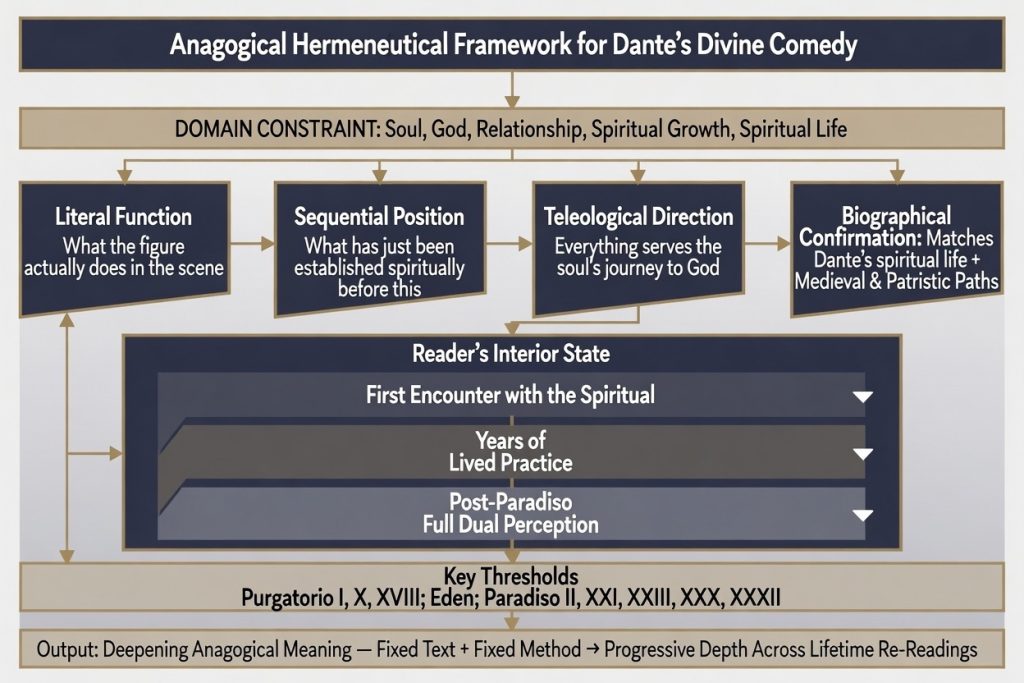
Key elements are:

1st: the domain is already defined. The anagogical is per definition about Soul, God, Relationship, Growth. This is explicitly decided beforehand by the writer.

2nd: we propose 4 tools for discernment and evaluation. These should be dwelt in one by one. What is essential is the “Sequential Position” or what in some hermeneutics would be called the “systematic interpretation”. Passage by passage in a canto build on the elements established right before. Without tracking this sequentially, the options become almost limitless. Considering the steps before, the set of contingent possibilities narrows significantly.

3rd: The overall aim, as teleological, is also given with its definition: the Soul’s Journey to God. But to consider how the elements in a passage might map onto the interior of the spiritual life and journey, one has to take into consideration the spiritual state and “position” on this path, for the reader. Thus we have outlined three examples, though there are infinite levels between them. But one can consider for example a first starter on the spiritual path, and one who has been doing practice for many years (also with experiences), and one who has experienced theosis, a direct touch of the Divine, and a full dual perception of spiritual and material realities and their dynamics continually, perhaps permanently.

So the anagogical meaning cannot be “one thing”. This makes this type of discernment infinitely rich, but also requiring some practice. One has to combine the 4 tools with a certain sense of where on the path internally a reader is. A scene like Trajan and the Widow is significantly different for someone who has just discovered the spiritual life, compared to one who has tried to combine these aspects for ten or twenty years already.

This also means that the capacity to use this method grows with time and practice, and insights to the anagogical meaning itself. The recursiveness is built into the layer, and into the poem. Which also confirms a core anagogical idea: gazing gives further insights, which then amplifies the ability to gaze deeper, which then gives further insight, and so on. Infinite richness, and a recursive process.

And this is why this hermeneutical method is somewhat different in nature. You know the type of outcome, you have 4 tools, and then you consider this in light of the reader’s current advancement. This is the rational path to distill the anagogical meaning, from Dante’s Divine Comedy.

Posted in Methodology | 6 Comments