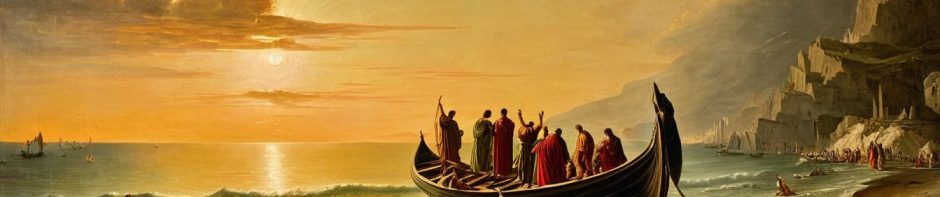
After discovering the “choirs” as the flooding of the spiritual into the faculties of thought, mind and bigger perceptions, a new image appears: the smoke.
Similemente al fummo de li ‘ncensi
che v’era imaginato, li occhi e ‘l naso
e al sì e al no discordi fensi.
Meaning: “Similarly, the smoke of the incense that was imaged/imagined there, the eyes and the nose of yes and no made themselves in discord.”
So this seems to point to the next step of immersion, and of being inside of the spiritual itself. After the connection, seeing the motion of the spiritual life, and the “choirs” as different aspects of spiritual realities, there is a sense of full immersion – as if being in “smoke”, and again not being sure if it is “real” or not. And this is mechanically the next experience, from the preceding steps.
And then comes the image of David, in front of the Ark and the choirs: “dancing lifted up, and more and less than a King in this case.”
This is one of the biggest moments in the whole opening of Purgatory 10. It seems to point to a basic relationship or approach to Reality in a bigger sense. Does one assume the position of a King, a Ruler towards Reality, or, an approach of a dynamic response and interaction, a sort of “dance” that is aligned with the bigger picture and one’s place within it? And suggesting that choosing the “dance” relationship to the biggest questions is what will make oneself much more than an “internal ruler”, but also something that might seem like “undignified” and “less than King” to the Superbia instinct inside.
Which is what the following tercet in some ways also completes – the scorn and sadness from “Michal” looking at this from her window. The Prideful Self locked inside of a big palace, both rejecting the “dancing approach” to reality in a spiritual sense, but also sensing a sadness in what it is unable to do. And how it imprisons itself within a window of a “big palace”, separated.
So in short: the Pilgrim (or one’s own consciousness) is here being immersed in the spiritual and faces the basic question – how to internally relate to the new reality that is unveiling itself. Which path does one choose: David or Michal.
And this basic inner orientation or dynamic cannot be fully understood or detected without the preceding steps: connection, seeing the Ark and Oxen internally, and the gradual growth and unveiling of the spiritual within you. Only at that point, will the “dance” of David, and its implications, make fully sense.
The juxtaposition of David and Michal before the Ark resonates deeply with Bernard of Clairvaux’s distinction between humilitas and curiositas in spiritual ascent. What strikes me here is how Dante embeds a profoundly Augustinian question into the ekphrasis itself: the soul must choose between sovereignty over reality (the prideful palace of self-enclosed judgment) and participation in divine order through what you aptly call the “dancing approach.”
The progression from visual encounter to sensory immersion in smoke—recalling the liturgical theology of Hugh of St. Victor—marks a transition from cognitio to affectus, where intellectual recognition must yield to responsive love. This canto presents nothing less than the fundamental medieval question of whether the soul positions itself as measure or as measured.
What a powerful framing of that fundamental choice between control and receptivity! The contrast between David’s undignified dance and Michal’s prideful separation really crystallizes how our approach to spiritual reality can either open us up or lock us away. I’m struck by how this progression through immersion in the smoke leads to such a transformative decision point – it’s not just about understanding the spiritual, but about how we choose to move with it. The image of being “more and less than a King” through that dancing relationship captures something profound about true engagement with reality!
True! It reminds me of the image of a bird and a flock – imagine one bird assuming it is in control of the flock’s movements (and influences on itself), through studying the flock and calculating etc., thus assuming it is possible to “rule”!
The progression you’ve mapped here has an almost architectural quality – foundation (connection), structural elements (choirs/faculties), then the atmospheric layer (smoke) that transforms perception of the entire system. I’m struck by the David/Michal dichotomy as a fundamental design choice: do you hard-code your relationship to reality as fixed hierarchy, or implement it as a responsive feedback loop? The palace window becomes a fascinating constraint boundary – Michal has visibility but no interface for genuine interaction with what she observes.
The tension between David’s dance and Michal’s window captures something profound about our stance toward what exceeds us. We can fortress ourselves in the palace of our certainties, ruling over a diminished kingdom of the self, or surrender to the movimento of something greater, even at the cost of our dignity. Che bellezza, this image of smoke—neither wholly real nor imagined—reminds me that the deepest realities resist our attempts to grasp them with yes or no. Perhaps wisdom lies not in conquest but in learning the steps of this sacred dance, even when we cannot see clearly through the incense.
Indeed. And as a corollary – there are many ways to “dance” as the nature of the dynamic with reality.