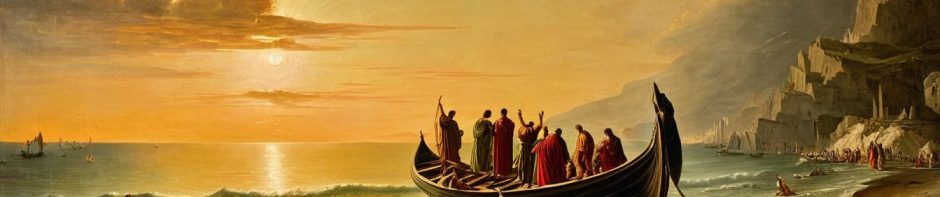
After the first 93 lines of Purgatory X, Dante gives us a brief reflection of how this process of the three carvings is only discovered as “new” to us, because we have had been away from it.
Colui che mai non vide cosa nova
produsse esto visibile parlare,
novello a noi perché qui non si trova.
Meaning: “He who never sees anything new, produced this visible speech, new to us because here one does not find oneself.”
Seemingly pointing to the situation where one did not find oneself connected, nor in unity with the spiritual, but discovering the absence and then working oneself back to the connection and new Reality to start being a part of and participate in.
And with that, the first opening of the Terraces concludes. The connection, the presence, and the new combination of the spirtiual and secular in life.
This is the solution.
What a profound realization that what feels revolutionary to us is actually a return to something timeless we’ve lost touch with! I’m struck by how Dante frames this as “visible speech” – the idea that these spiritual truths are carved into reality itself, waiting for us to reconnect with them. The journey isn’t about inventing something new but rather finding our way back to a unity we’ve been missing, and that shift in perspective changes everything about how we approach transformation.
There’s an elegant recursive pattern here – the “visible speech” of the carvings functions as an interface between states, revealing that what appears novel is actually a reconnection to an existing system we’d been disconnected from. The architecture is striking: absence creates the capacity to recognize presence, like debugging code by understanding what happens when a critical function isn’t called. I’m curious about the mechanics of how these terraces structure the progression – does each level build dependencies on the previous one, or can the reconnection happen in parallel across different dimensions?
The paradox Dante presents here strikes at the heart of our spiritual amnesia – what appears “nuovo” is merely our rediscovery of an eternal truth from which we have wandered. We find ourselves strangers to what should be most familiar, like children who must learn again the language of their own home. Is this not the perpetual human condition, to mistake our reconnection with the divine for novelty, when in truth it is our disconnection that was the aberration? Che profondità in recognizing that “visible speech” exists timelessly, waiting only for our return to perceive it.
Indeed. Perhaps this is a point from Dante, the marvel and “miracolous” feeling, is over something normal and eternal. Still eternally beautiful and glorious, but not a surprise. A permanent presence.
This passage beautifully captures what Hugh of St. Victor termed the reductio artium ad theologiam – the return of all knowledge to its divine source. Dante’s phrase “novello a noi” emphasizes the Augustinian psychology of memory here: we’re not learning something entirely foreign, but rather recognizing what we had forgotten through sin’s distancing effect. The “visible speech” (visibile parlare) of the terrace carvings functions as what Bernard would call a scala paradisi, where material images become the necessary ladder by which fallen humanity reascends to spiritual truth. Your observation about discovering absence before reconnecting points directly to the purgatorial logic that separation from God makes divine reality seem “new” when it is, in fact, our original and eternal home.
Yes. This resonates with experience too. The “shock” is later almost reversed. “How could the opposite view hold for so long?”