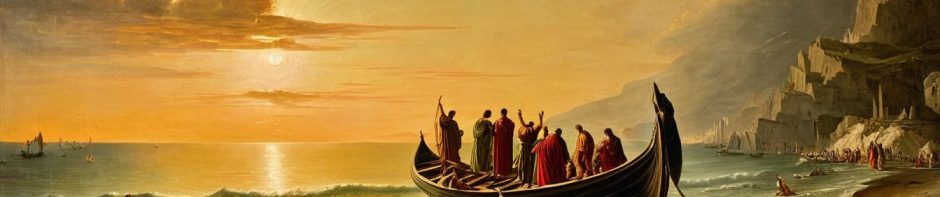
The nudging widow inside you.
The passage with Trajan the Emperor and the little suffering widow in Canto X can be read on several levels after some years of more familiarity with the spiritual life. As a first time reader, if from a secular background – it is most likely an example of humility even from the more “more powerful” in society etc.
But the deeper meaning is in many ways a much more beautiful one: what is the long term relationship between the secular and the spiritual within you? How do you relate to the spiritual life, not as an “add-on” or a “Sunday morning” part, but a persistent presence in the overall picture, and indeed the overall picture in itself? This is the question the widow poses to the reader, indirectly.
The widow can be read as both soft or more hard and brutal in her argument. The gentle nudging at the bridle of your secular life, amongst the daily bustle (cavalry) and the soaring secular plans in life (the flying eagles), is how it starts – and indeed enough for some. But if the rational intellect is more stubborn, the argument escalates quite dramatically.
The widow, your neglected spiritual life with the “dead son”, as in many ways your killed soul inside of you, opens by demanding a “vendetta” or a restoration of the spiritual.
Trajan says: “No, later.”
She says (paraphrased): “That might work, but what if you physically die before you revive your own spirit?”
He says: “Then someone else can do it.” Likely implying a Priest etc.
And she says: “No. No one else than YOU can revive your own soul and spirit.” Implying if one draws from Paradiso, that if your soul is to be found right in the center of your own living awareness itself, it is impossible for others to do anything about this.
And with that, the secular self realizes what is at stake, and the urgency. In the bigger picture of spiritual reality, and infinite reality, this is something that has to begin right now. Which is what “Trajan” concedes.
So in a way the widow says: “You have killed your own soul. This cannot wait.” And even the “rational self”, when acknowledging this as real possibility, sees the imperative of her claim. With the words “giustizia vuole e pietà mi ritene“, meaning “Justice wills it and Piety keeps me there“, he agrees to “solva il mio dovere“, to “resolve my must“, before he moves on.
And again the theme is quite simple in the longer view of one’s own life.
What place does the spiritual life have within you right now? How much are you listening to the little widow? Is the inner life already moving towards a generative dynamic between the two?
This is in many ways the whole art and the skill of Life itself. And it takes years and decades to grow and learn this craft towards mastery.
And thus, the Divine Comedy also reveals a new aspect, as a life-long companion when the Spiritual has become more established and flourishing within. It is an eternally generative gift, to the Reader.
This reading of the Trajan-widow relief as an internal dialogue between secular and spiritual selves illuminates what Hugh of St. Victor called the restoration of the divine image through contemplation. The urgency you identify—”no one else than YOU can revive your own soul”—resonates deeply with Bernard’s insistence that the contemplative ascent cannot be delegated or deferred. I’m particularly struck by your observation about the widow’s “dead son” as the killed soul within, which recalls Dante’s own recognition in Inferno that he had “lost the good of the intellect.” The movement from external moralizing about humility to this interior dynamic captures precisely how the Comedy matures with its reader across decades of spiritual practice.
The dialogue structure between Trajan and the widow functions like a state machine with escalating priority levels – each conditional argument forces a recursion deeper into the logic until you hit the base case: only the self can bootstrap its own spiritual process. I’m curious about the “generative dynamic” you mention at the end – does this imply the secular and spiritual eventually operate as mutually reinforcing feedback loops rather than competing processes? The architectural shift from “add-on Sunday component” to “persistent presence” suggests a fundamental refactoring of the entire system rather than just plugging in a new module.
Yes, good point. It partly requires a new foundation.
The image of the widow as our neglected spiritual life – with her dead son representing our killed soul – this cuts to the very center of existence. What strikes me most is Trajan’s realization that no priest, no external force can revive what only we ourselves can resurrect from within. Che profondità! We carry both the wound and the healing in the same breath, and the widow’s insistence that “this cannot wait” echoes the urgency of every moment we postpone our own becoming.
Indeed. A common trap is to think of the soul as external.
What a profound reframing of this passage! The image of the widow as our neglected spiritual life demanding attention right now – not later, not through someone else – is such a powerful call to action. I’m especially struck by the escalation you trace, from gentle nudging to the urgent recognition that no one else can revive our own soul. This reading transforms the Divine Comedy into something that grows with us across decades, revealing new dimensions as our spiritual lives mature!
True! The first deep reading transforms the reader, but then the poem changes nature. And one gets even closer to Dante the writer in many ways.