
Long time readers will know well how a recurring argument for our decade long work on Dante’s Comedy is the lack of the “fourth meaning” in Dante Scholarship in the last 200 years, or likely much longer.
Dante writes at 4 levels:
- Literal (what is literally happening)
- Allegorical (in effect all symbolism except the anagogical)
- Moral (which moral teaching is expressed)
- Anagogical (how this expresses growth and ascent upwards, spiritually)
Of which the last is the deepest and primary, per Dante himself. The word means “ana gogy” as in “up leading” in Greek, meaning that this level expresses insights and wisdom about spiritual growth and ascent towards the Divine, in short: the Soul’s Journey to God.
Until now this level has been dismissed, overlooked, or often deemed too “subjective” or “personal” to be the object of serious academic and intellectual study and discernment. But this is absurd. Even if this level might require personal experience to be fully understood, it is still defined as the primary meaning of the work. Thus it needs to be at the minimum explained in its intention, and for this we are now proposing an early version of a rational anagogical hermeneutical method:
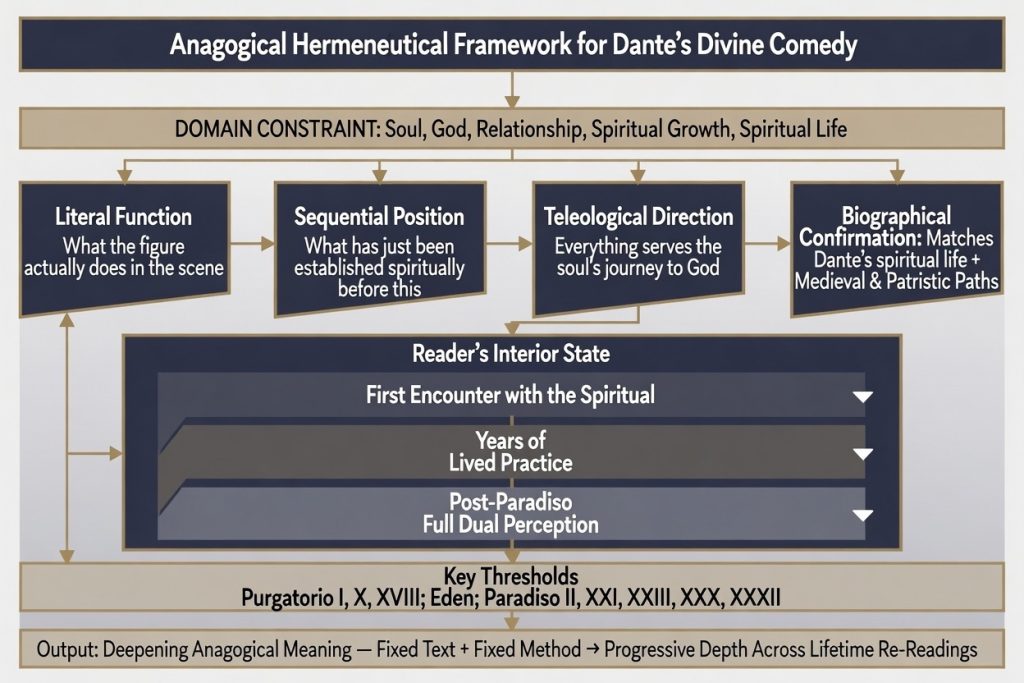
Key elements are:
1st: the domain is already defined. The anagogical is per definition about Soul, God, Relationship, Growth. This is explicitly decided beforehand by the writer.
2nd: we propose 4 tools for discernment and evaluation. These should be dwelt in one by one. What is essential is the “Sequential Position” or what in some hermeneutics would be called the “systematic interpretation”. Passage by passage in a canto build on the elements established right before. Without tracking this sequentially, the options become almost limitless. Considering the steps before, the set of contingent possibilities narrows significantly.
3rd: The overall aim, as teleological, is also given with its definition: the Soul’s Journey to God. But to consider how the elements in a passage might map onto the interior of the spiritual life and journey, one has to take into consideration the spiritual state and “position” on this path, for the reader. Thus we have outlined three examples, though there are infinite levels between them. But one can consider for example a first starter on the spiritual path, and one who has been doing practice for many years (also with experiences), and one who has experienced theosis, a direct touch of the Divine, and a full dual perception of spiritual and material realities and their dynamics continually, perhaps permanently.
So the anagogical meaning cannot be “one thing”. This makes this type of discernment infinitely rich, but also requiring some practice. One has to combine the 4 tools with a certain sense of where on the path internally a reader is. A scene like Trajan and the Widow is significantly different for someone who has just discovered the spiritual life, compared to one who has tried to combine these aspects for ten or twenty years already.
This also means that the capacity to use this method grows with time and practice, and insights to the anagogical meaning itself. The recursiveness is built into the layer, and into the poem. Which also confirms a core anagogical idea: gazing gives further insights, which then amplifies the ability to gaze deeper, which then gives further insight, and so on. Infinite richness, and a recursive process.
And this is why this hermeneutical method is somewhat different in nature. You know the type of outcome, you have 4 tools, and then you consider this in light of the reader’s current advancement. This is the rational path to distill the anagogical meaning, from Dante’s Divine Comedy.
Your emphasis on sequential position as a hermeneutical key resonates deeply with the medieval practice of lectio divina, where each passage builds upon what precedes it in a progressive unveiling of spiritual truth. I’m intrigued by your acknowledgment that anagogical meaning necessarily shifts with the reader’s spiritual state—this aligns with Hugh of St. Victor’s insistence that contemplative reading requires the reader’s own purgation and illumination. The recursive nature you describe mirrors Bernard of Clairvaux’s concept of the soul’s circular ascent, where each return to the text at a higher spiritual level reveals what was previously veiled. This method seems to restore what Aquinas and the medieval commentators understood: that Dante’s Comedy functions as a spiritual exercise, not merely an object of detached analysis.
What a breakthrough approach to recovering something so essential that’s been missing for centuries! The idea that the anagogical meaning shifts and deepens based on where the reader stands on their own spiritual journey is profound – it transforms Dante’s work into a living guide rather than a static text. I’m particularly struck by how you’ve made the “subjective” element rigorous through your four-tool method while honoring that recursive deepening process. This could revolutionize how we engage with transformative literature across traditions!
The recursive nature of this hermeneutical method is fascinating—essentially creating a feedback loop where the tool itself improves through use, much like how profiling optimizes code through runtime data. I’m particularly intrigued by how you’ve constrained what could be an infinitely subjective problem space: fixing the domain parameters upfront, then using sequential position as a key limiting function. How do you handle edge cases where two readers at similar “advancement levels” might derive contradictory anagogical meanings from the same passage? The system seems elegant but I’m curious about its error-correction mechanisms.
What strikes me profoundly is this recursive nature you describe – that the very act of contemplating the anagogical deepens our capacity to perceive it, creating an infinite spiral of understanding. The dismissal of this fourth level as “too subjective” reveals perhaps our modern fear of that which transforms the observer in the act of observation. When you speak of the widow and Trajan holding different meanings for souls at different stages of their journey, you touch something essential: can a method truly capture the Divine if it does not itself participate in the movement upward? Che bellezza – a hermeneutics that grows with the soul it serves!
I like this a lot! The step of testing based on Dante’s life and/or medieval practice is great, too; it stops things from getting too caught in the reader’s individual framework. The visual is great!
Thank you so much! Love your thougths here. And it is kind of a small “breakthrough” in the research, that it IS possible to rationally apporach the anagogical as well.
And yes – I’ve used Dante’s life and path so many times in the last few years, to get hints of the meaning. And it often produces a wealth of new understanding.