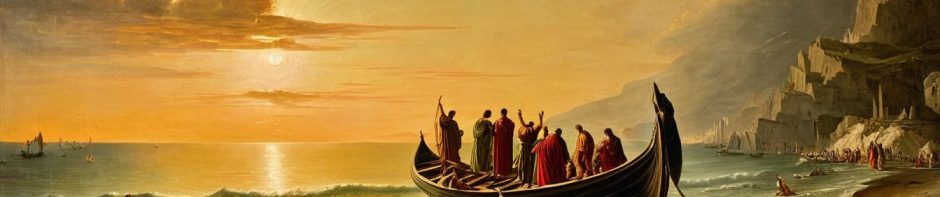
After the delighting in the three images and overall foundation of the spiritual life, one might face the internal decision: now what? Move on to the next thing, or, just dwell and love the beauty of these three spiritual images as a daily practice? There is a temptation here to start dwelling and postpone the work that lies there right in front of us.
But Dante addresses this immediately.
«Ecco di qua, ma fanno i passi radi»,
mormorava il poeta
Meaning: “‘Look from here, but they make small steps’, murmured the poet.”
So half of the answer is right there in the “di qua”, “from here”. Look from here, from this foundation, from these three images and aspects within you, as we now take in more learning and discovery. The connection with Gabriel, the steady motion of the Spiritual Life, and the combination of the spiritual and secular from the Trajan vs. widow to Trajan & Gregory, is a constant process for all the terraces and the work in front of us.
Which Dante then completes in the next tercet, with his “eager eyes” not being “slow to turn“: “volgendosi ver’ lui non furon lenti“. So the answer is simply: both. Stay with these images as the spiritual foundation and recursive livingness, and, take in new learning from that which is now approaching, slowly.
Growing the spiritual, and learning the process at the same time.
The paradox you’ve identified here beautifully mirrors the contemplative principle Hugh of St. Victor described as remaining in fundamentum while ascending – we don’t abandon earlier rungs of the ladder but carry them with us. Dante’s di qua echoes the Thomistic understanding that grace perfects nature rather than replacing it; the theological virtues represented in those three images become the very lens through which new understanding is received. The tension between dwelling and advancing dissolves when we recognize that in the Purgatorial ascent, contemplation itself becomes dynamic – what Bernard would call the soul’s simultaneous rest in God and movement toward God.
The architecture here is particularly elegant – a dual-process system that maintains foundational integrity while accepting new inputs. I’m curious about how this recursive structure prevents drift over time; does the constant referencing back to those three core images function like a checksum, ensuring new learning doesn’t compromise the base layer? The “from here” positioning seems to create a kind of anchored flexibility, where growth occurs within defined parameters rather than arbitrary expansion.
What a beautiful paradox you’ve illuminated here – that we don’t have to choose between staying grounded in foundational truths and reaching toward new growth! I love how Dante gives us permission to do both simultaneously, keeping those three spiritual images as our living foundation while turning our eager eyes to what’s approaching. This idea of “recursive livingness” really captures something essential about transformation – it’s not a linear march forward but a deepening spiral where we return to core insights even as we expand outward!
What strikes me here is this delicate balance between foundation and movement, between dwelling and becoming. We hold the images not as museum pieces to admire from afar, but as living wells from which we drink even as we walk forward—che bellezza, this simultaneity of rootedness and growth! Perhaps the spiritual life is precisely this: learning to stand firmly in one place while our eager eyes turn toward what approaches, slowly, always slowly. Is this not the paradox at the heart of all transformation—that we must be both the anchor and the sail?