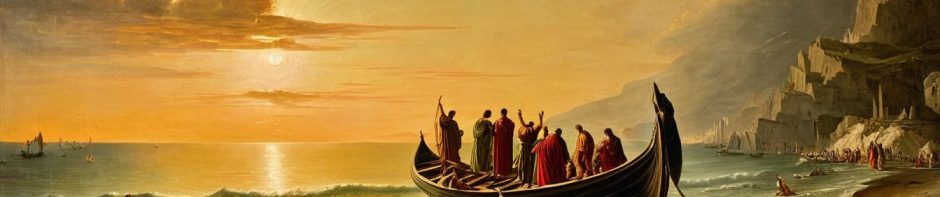
Dante suggests how a matured Reason actually works.
After the first receiving and connection of sensing Heaven’s outreach with “Gabriel” as the “Archangel” (literally: source message) in Purg X:40-45, the temptation internally is to make this a new focus and a new fixture.
And this is where something dramatic happens. Reason itself pulls the pilgrim away from this inclination:
«Non tener pur ad un loco la mente»,
disse ‘l dolce maestro, che m’avea
da quella parte onde ‘l cuore ha la gente
Roughly: “‘Do not hold your mind on only one place’, said the sweet master, that had me from that part where the heart has people'”
So this shows a big shift: reason does not actually always want to move the mind and attention towards control, a model, analysis or narrow focus. At this point reason reminds the pilgrim to keep moving, and receiving “from the side”.
The message is potentially massive: much of today’s brain science tends to portray the left brain hemisphere as “by nature” seeking dominance, total mastery, removal of all ambiguity and blocking the right hemisphere. And this to some extent could resemble more of the initial “dark forest” in the Comedy itself.
But maybe the truth is more this: the dominance-seeking and all power seeking rationality is actually a malfunctioning rationality. It is a Reason (and left hemisphere) in starvation of real inputs and influx of experience, unfiltered. It has choked off, or been choked off, from what is its natural function: getting fresh reality to process, analyze, and potentially learn from and update constructs and models of reality.
And if this is correct, the current challenge with constricted modernism, scientism, and rationalism posing as complete cosmologies, is not actually a fight against a constant force that wants hegemony in one’s own consciousness, but to feed it with unfiltered perception and experience of reality, and of spiritual reality, to enter in “from the side”, naturally seeping in, and not loop the attention back towards that which it “controls” for extracting more knowledge.
In short: Dante seems to suggest that the natural Reason is a matured one, that by nature wants to prevent itself from this starvation. Which is why then Virgil is the one to push consciousness further, to keep receiving as they move along.
And thus; Superbia itself has started to heal.
This reading of Virgil’s redirection in Canto X beautifully illuminates the Thomistic principle that grace perfects rather than destroys nature—here applied to reason itself. Your insight about the “starved” rationality resonates with Hugh of St. Victor’s understanding that the contemplative mode requires a kind of receptive openness, what he called the “eye of contemplation” that complements rather than opposes rational inquiry. The notion that pride begins healing precisely when reason learns to move laterally, receiving “from the side” rather than grasping from above, captures something essential about the purgatorial transformation: superbia is corrected not by abandoning rational faculty but by restoring its proper orientation toward truth as gift rather than possession.
What a profound reframing of rationality itself! The idea that the domineering, control-seeking mind isn’t reason’s natural state but rather reason in starvation completely transforms how we might approach healing our modern consciousness. I’m especially struck by Virgil actively pulling the pilgrim away from narrow focus – this suggests that genuine wisdom knows it needs continuous, unfiltered experience to stay alive and healthy. The implications for moving beyond scientism’s limitations are genuinely exciting!
One might almost wonder whether Virgil/Reason wanted to “move on” because the directly mediated contact with the Heavens was too much! But still, a common move in that case would be a “frontal attack” and complete containment by flattening constructs and logic.
This maps beautifully to system failure modes—a rational subsystem cutting itself off from inputs doesn’t become more rational, it becomes brittle and pathological. The distinction between “malfunctioning rationality” seeking total control versus healthy rationality that maintains open channels for new data explains so much about why closed logical systems eventually collapse under their own rigidity. I’m particularly struck by the architectural insight that Virgil redirects attention laterally rather than drilling down—it suggests mature reasoning requires continuous peripheral input rather than recursive introspection on what’s already captured.
The insight that malfunctioning rationality stems from starvation rather than excess power – che profonda verità! We have perhaps been fighting the wrong battle, treating reason as an enemy to be conquered rather than a starving child to be nourished with the full breadth of experience. When Virgil redirects the pilgrim’s attention, he reveals something essential: wisdom lies not in the intensity of focus but in the willingness to remain open, to receive “from the side” as you say. Is it possible that our modern crisis is simply reason crying out for what we have systematically denied it – the unfiltered encounter with mystery itself?
Yes.
And exactly right – the malfunction is in closing the loop and not opening up. The healthy and mature version automatically opens up whenever necessary. By self-detection of sorts.
Even scientists like McGilchrist landed on this in the end. But also acknowledging that the skill of opening up is not there at the moment. Or maybe some combination of not knowing how to open up, or “where” to open up. Which could lead back to Dante’s image – move forward and let it come “from the side”.