The Force that descends upon the Distortions

As the process of purgation is slowly approaching, and the Pilgrim is unsure of whether he is mistaken about what he sees, Virgil as rationality starts speaking:

Ed elli a me: «La grave condizione 
di lor tormento a terra li rannicchia, 
sì che ‘ miei occhi pria n’ebber tencione.   

Meaning: “And he to me: ‘The grave condition of their torment bends them to the ground, yes so my eyes at first had contention.'”

Again our own intuitive anagogical interpretation was the following: “they” are here your inner distortions of Superbia. And as the process of purgation is arriving, it seems like this is how the force of the spiritual process itself slowly squashes the distortions down into the ground, thereby healing your misunderstandings and inner structures.

Then, running it through the new hermeneutical method: Continue reading →

Posted in Methodology, Purgatory | 4 Comments

The Nature of the Process Approaching You

Where intuition and rational analysis concur.

After delighting in the three spiritual images, and finding the rational argument to continue the process, the Pilgrim begins to speak to Virgil.

Io cominciai: «Maestro, quel ch’io veggio
muovere a noi, non mi sembian persone,
e non so che, sì nel veder vaneggio».

Meaning: “I began: ‘Master, that which I see moving towards us does not seem like people, and I don’t know if yes in this seeing, I am mistaken.”

So this seems like an incredibly deep description of the first encounter of the spiritual process of purgation and repairing the distortions internally. It does not seem like people because it is a much bigger and eternal process, starting to move in the deep of consciousness here (as the Pilgrim). And the Pilgrim further also does not know if this sense of the process is mistaken or not.

So this was our first intuitive approach to the anagogical meaning of this tercet. Continue reading →

Posted in Methodology, Purgatory | 6 Comments

The Argument for Purgation

After the new insights of the spirtual life, and also how to combine this with continuously new insights – Dante gives us a direct address and the reasons why one should continue.

The argument is very simple: do not focus on the nature of the fixing. Focus instead on:
a) the rewards from it
b) that doing nothing is at least as bad, but likely a lot worse

And this becomes the whole choice. Repairing distortions and Superbia gives great rewards, and doing nothing is worse.

Then the journey continues.

Posted in Purgatory | 4 Comments

Applying the Anagogical Interpretation Method

We will now try to apply and double check our last reading with the new anagogical method and the four tools of discernment.

The passage is the following:

«Ecco di qua, ma fanno i passi radi»,
mormorava il poeta, «molte genti:
questi ne ‘nvieranno a li alti gradi». 

Li occhi miei ch’a mirare eran contenti
per veder novitadi ond’e’ son vaghi,
volgendosi ver’ lui non furon lenti.

Roughly:

“Look from here, but they take slow steps
murmured the poet, “many people:
these will send us to the higher grades”

“My eyes that were content in looking
To see new things of which they are eager,
were not slow to turn themselves towards him.”

First, we know that this has to be about the soul, God, relationship, spiritual growth or the spiritual journey. This is always a given for the anagogical level – if it is really there.

Then the four tools; first the literal: The poet Virgil tells the Pilgrim to look at many people who are taking small steps, from here. He further says they will send them higher up on the mountain, and the Pilgrim says that even as he was content with looking (presumably still at the carvings as that which was the last focus of his vision), his eyes are eager for new things, so he quickly turns his gaze towards Virgil. So literally, Virgil says: look from here towards the new, and the Pilgrim turns his eyes at once.

Sequential reading: we have just discovered the overall spiritual process and nature of the spiritual life with three images. The Pilgrim was delighting in these, also as they were precious to behold because of their maker. This means the current insight should be connected to this discovery and established presence. How to combine the overall discovery with continuous new spiritual insight is directly building on this.

Teleological: The meaning has to fit into the broader journey of the Soul from isolation towards the Heavens and the Divine. And the passage describes how to combine both what was just established, and, that one also has to take in new impressions. This would be an essential part of growth of the soul itself. Thus it is both relevant, and a good fit.

Biographical: Dante himself went through a learning process, very likely exactly as described here. Discovering and opening to a new approach with a recursively generative foundation, and a foundation to come back to, while absorbing new insights to keep growing. This would fit as Dante describing and reflecting on his own journey and process in his mid-thirties to mid-forties.

Conclusion: All the four tools fit well with the reading. Lifting the sights for new learning whilst remaining grounded in the established discoveries, gives good practical advice for the further anagogical journey. The method does not in this case directly produce the insights, but it points towards them, and fully confirms that there are no contradictions.

Posted in Methodology | 4 Comments

Keeping the Images – and – Taking in More

After the delighting in the three images and overall foundation of the spiritual life, one might face the internal decision: now what? Move on to the next thing, or, just dwell and love the beauty of these three spiritual images as a daily practice? There is a temptation here to start dwelling and postpone the work that lies there right in front of us.

But Dante addresses this immediately.

«Ecco di qua, ma fanno i passi radi»,
mormorava il poeta

Meaning: “‘Look from here, but they make small steps’, murmured the poet.”

So half of the answer is right there in the “di qua”, “from here”. Look from here, from this foundation, from these three images and aspects within you, as we now take in more learning and discovery. The connection with Gabriel, the steady motion of the Spiritual Life, and the combination of the spiritual and secular from the Trajan vs. widow to Trajan & Gregory, is a constant process for all the terraces and the work in front of us.

Which Dante then completes in the next tercet, with his “eager eyes” not being “slow to turn“: “volgendosi ver’ lui non furon lenti“. So the answer is simply: both. Stay with these images as the spiritual foundation and recursive livingness, and, take in new learning from that which is now approaching, slowly.

Growing the spiritual, and learning the process at the same time.

Posted in Discernment, Purgatory | 4 Comments

Building a Method for Interpretation of the Anagogical Meaning in Dante’s Divine Comedy

Long time readers will know well how a recurring argument for our decade long work on Dante’s Comedy is the lack of the “fourth meaning” in Dante Scholarship in the last 200 years, or likely much longer.

Dante writes at 4 levels:

  • Literal (what is literally happening)
  • Allegorical (in effect all symbolism except the anagogical)
  • Moral (which moral teaching is expressed)
  • Anagogical (how this expresses growth and ascent upwards, spiritually)

Of which the last is the deepest and primary, per Dante himself. The word means “ana gogy” as in “up leading” in Greek, meaning that this level expresses insights and wisdom about spiritual growth and ascent towards the Divine, in short: the Soul’s Journey to God.

Until now this level has been dismissed, overlooked, or often deemed too “subjective” or “personal” to be the object of serious academic and intellectual study and discernment. But this is absurd. Even if this level might require personal experience to be fully understood, it is still defined as the primary meaning of the work. Thus it needs to be at the minimum explained in its intention, and for this we are now proposing an early version of a rational anagogical hermeneutical method:
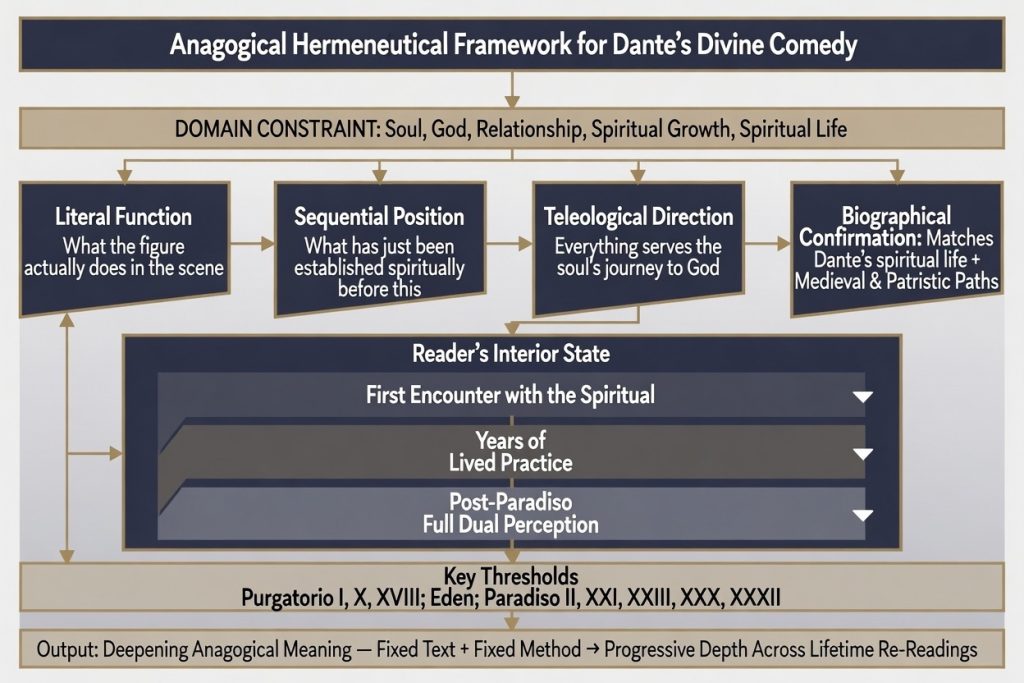
Key elements are:

1st: the domain is already defined. The anagogical is per definition about Soul, God, Relationship, Growth. This is explicitly decided beforehand by the writer.

2nd: we propose 4 tools for discernment and evaluation. These should be dwelt in one by one. What is essential is the “Sequential Position” or what in some hermeneutics would be called the “systematic interpretation”. Passage by passage in a canto build on the elements established right before. Without tracking this sequentially, the options become almost limitless. Considering the steps before, the set of contingent possibilities narrows significantly.

3rd: The overall aim, as teleological, is also given with its definition: the Soul’s Journey to God. But to consider how the elements in a passage might map onto the interior of the spiritual life and journey, one has to take into consideration the spiritual state and “position” on this path, for the reader. Thus we have outlined three examples, though there are infinite levels between them. But one can consider for example a first starter on the spiritual path, and one who has been doing practice for many years (also with experiences), and one who has experienced theosis, a direct touch of the Divine, and a full dual perception of spiritual and material realities and their dynamics continually, perhaps permanently.

So the anagogical meaning cannot be “one thing”. This makes this type of discernment infinitely rich, but also requiring some practice. One has to combine the 4 tools with a certain sense of where on the path internally a reader is. A scene like Trajan and the Widow is significantly different for someone who has just discovered the spiritual life, compared to one who has tried to combine these aspects for ten or twenty years already.

This also means that the capacity to use this method grows with time and practice, and insights to the anagogical meaning itself. The recursiveness is built into the layer, and into the poem. Which also confirms a core anagogical idea: gazing gives further insights, which then amplifies the ability to gaze deeper, which then gives further insight, and so on. Infinite richness, and a recursive process.

And this is why this hermeneutical method is somewhat different in nature. You know the type of outcome, you have 4 tools, and then you consider this in light of the reader’s current advancement. This is the rational path to distill the anagogical meaning, from Dante’s Divine Comedy.
Posted in Methodology | 6 Comments

The opening of Purgatorio X

Three Images for Life.

The three carvings in Purgatory 10 are a unique and lingering passage, with three artworks that simply sums up the Spiritual Life in its growth and presence. There are dramatic scenes and passages about rebirthing the soul later, and exploring the Spiritual Realm, being in God, and sensing the touch of God for the first time perhaps, at least consciously understanding what is happening.

But Purg X:1-99, gives us three carvings to carry with us for life.

The outreach from God, the slow, robust, forceful motion of the spiritual through your lifetime, and the growing presence of both the secular and spiritual in one’s normal life.

In a sense, the biggest questions of Life at all.

Just remember these three carvings. And as Dante himself writes at the end of it; delight in their beauty and preciousness. That this is indeed a part of life, is a miracle in itself.

Posted in Purgatory | 4 Comments

A Moment of Bliss

After the experience and understanding of the three marble carvings in Purgatory X  have started to sink in, the Pilgrim (here almost as conscious afterthought), looks at them and delights in their beauty.

Mentr’io mi dilettava di guardare
l’imagini di tante umilitadi,
e per lo fabbro loro a veder care,

Meaning: “Whilst I delighted in looking at the images of much humility, that by/because of their maker are precious to see”.

So we have a simple a moment of pure bliss, appreciation, and marvel at the beauty of this process and spiritual nature of healing and health bringing. The process is built into nature and reality itself, as that which brings one back from separation, and into a richer presence and participation in fuller Reality.

These images express the dynamic of spiritual reconnection and also gratitude, that in many ways is the whole purpose of the Divine Comedy. Finding back to fuller Reality, healing the distortions internally, and experience the infinite richness of true participation and communion, with the livingness of the eternal spirit.

Posted in Purgatory | 6 Comments

New for us, a Timeless Process

After the first 93 lines of Purgatory X, Dante gives us a brief reflection of how this process of the three carvings is only discovered as “new” to us, because we have had been away from it.

Colui che mai non vide cosa nova
produsse esto visibile parlare,
novello a noi perché qui non si trova.

Meaning: “He who never sees anything new, produced this visible speech, new to us because here one does not find oneself.”

Seemingly pointing to the situation where one did not find oneself connected, nor in unity with the spiritual, but discovering the absence and then working oneself back to the connection and new Reality to start being a part of and participate in.

And with that, the first opening of the Terraces concludes. The connection, the presence, and the new combination of the spirtiual and secular in life.

This is the solution.

Posted in Purgatory | 6 Comments

From Widow to Gregory Internally

Today’s reflection is the first one without moving further into the poem. This is more the overall view of what Dante is doing in the first half of Canto X in Purgatorio – read from two different stages of spiritual growth and insights.

In the longer view this is about changing the separated spiritual life within; into a “spiritual leader” within, as in having a “Pope Gregory” internally, together with a secular leader – of a “Trajan”.

From separation to a matured and fuller life, with both the secular and the spiritual, Dante thus outlines the following process:

  • The first opening with “Gabriel”. This is complicated.
  • The steady presence of the spiritual life within you. The Ark & Oxen.
  • The changing of the widow to the “pope” in one’s overall cosmology.

And these are the three carvings – seen from a long term view of one’s own life.

This could and often does, take decades.

But once discovered and become more familiar with, the clarity is almost stunning and effortless. All the pieces fall into place.

So in addition to a detailed discernment of symbolism and anagogical meaning, there is a wonderful “homecoming” sense in these passages too. Of how life will find a new rhythm and sense of being, after the changes, after the acknowledgement of the “dark forest”, and after the process of the Comedy.

Things change. One arrives. And then a new life also begins. A richer, more natural, and much more aligned with the fullness of Reality.

Posted in Purgatory, Reflections | 8 Comments