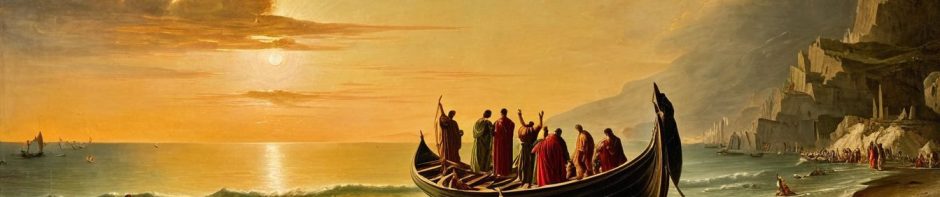
A Maturing Spiritual Life – and Internal Dynamics

The nudging widow inside you.

The passage with Trajan the Emperor and the little suffering widow in Canto X can be read on several levels after some years of more familiarity with the spiritual life. As a first time reader, if from a secular background – it is most likely an example of humility even from the more “more powerful” in society etc.

But the deeper meaning is in many ways a much more beautiful one: what is the long term relationship between the secular and the spiritual within you? How do you relate to the spiritual life, not as an “add-on” or a “Sunday morning” part, but a persistent presence in the overall picture, and indeed the overall picture in itself? This is the question the widow poses to the reader, indirectly.

The widow can be read as both soft or more hard and brutal in her argument. The gentle nudging at the bridle of your secular life, amongst the daily bustle (cavalry) and the soaring secular plans in life (the flying eagles), is how it starts – and indeed enough for some. But if the rational intellect is more stubborn, the argument escalates quite dramatically.

The widow, your neglected spiritual life with the “dead son”, as in many ways your killed soul inside of you, opens by demanding a “vendetta” or a restoration of the spiritual.

Trajan says: “No, later.”

She says (paraphrased): “That might work, but what if you physically die before you revive your own spirit?”

He says: “Then someone else can do it.” Likely implying a Priest etc.

And she says: “No. No one else than YOU can revive your own soul and spirit.” Implying if one draws from Paradiso, that if your soul is to be found right in the center of your own living awareness itself, it is impossible for others to do anything about this.

And with that, the secular self realizes what is at stake, and the urgency. In the bigger picture of spiritual reality, and infinite reality, this is something that has to begin right now. Which is what “Trajan” concedes.

So in a way the widow says: “You have killed your own soul. This cannot wait.” And even the “rational self”, when acknowledging this as real possibility, sees the imperative of her claim. With the words “giustizia vuole e pietà mi ritene“, meaning “Justice wills it and Piety keeps me there“, he agrees to “solva il mio dovere“, to “resolve my must“, before he moves on.

And again the theme is quite simple in the longer view of one’s own life.

What place does the spiritual life have within you right now? How much are you listening to the little widow? Is the inner life already moving towards a generative dynamic between the two?

This is in many ways the whole art and the skill of Life itself. And it takes years and decades to grow and learn this craft towards mastery.

And thus, the Divine Comedy also reveals a new aspect, as a life-long companion when the Spiritual has become more established and flourishing within. It is an eternally generative gift, to the Reader.

Posted in Purgatory | 7 Comments

A new Relationship with the Spiritual – At First

The widow as the first return of the Spiritual, into your secular life.

After the main theme of the third carving is presented, Dante describes how this new relationship between “Trajan” and “Gregory” internally might start out at first – after returning from spiritual experience and back to daily or normal life, when the secular “ruler” (as “Trajan”) is the main focus.

And the description is incredible. At the bridle of your secular-earthly life, there suddenly appears a little widow in tears and in suffering. As an image of your rejected or detached spiritual life, that has been in suffering from this separation.

The image of Trajan then continues with two main ideas: the bustle of your daily earthly activities as “crowded and full of cavalries”, and, your big view overall plans for your life – as golden eagles flying and soaring above, and moved by the winds.

In Italian:

Intorno a lui parea calcato e pieno
di cavalieri, e l’aguglie ne l’oro
sovr’essi in vista al vento si movieno.

Meaning: “Around him appeared crowded and full of cavalries, and the eagles in gold over him in view, in the wind they moved“.

The imagery is powerful in terms of the experience of one’s own secular aspect of life, and also in how your long term plans, as golden eagles, might seem glorious and perhaps even obvious and self-given, but in reality they are in part moved by “winds”, by external forces and perhaps even to some extent shifting and random external “trends” as to how one’s life should be lived and directed.

But either way the imagery of the secular and “ruled” life is one of restlessness. And now, after the internal experiences of the first two carvings, something is nudging at the guidance of this secular life in this third carving, the “bridle” of it. A little widow in sorrow.

This image is reminiscent of figures like Beatrice, Matelda, Piccarda, even Virgin Mary that will appear later. But for now, it is more focused on the very birth of something new: a birth of a new dynamic between your earthly secular “ruler”, and what will be growing as your spiritual aspect and life, in a recursive churning that eventually gives also infinite emergence.

So in a way: this appearance of the little widow, is the first glimpse of what eventually will grow into moving “Gregory” inside to a great victory; a growing fulfillment of the incarnation internally, the spiritual and the rational-secular in a new relationship, and an eternal churning of two asymmetrical dimensions.

In a way: the “chariot” itself, is here beginning to take form.

Posted in Purgatory | 8 Comments

The Secular and Spiritual Inside

After the first 69 lines of Canto 10 a major argument has already been laid out, and is in some ways concluded in its initial form: discovering (or re-discovering) the spiritual life, the connection key to it, how it immerses your being and faculties, and how to relate to it.

And then Dante seems to change focus back to the overall view, to the dynamic or unity of the earthly and the heavenly – since we now have a new presence of the heavenly internally. In terms of the story and poem, this was not the case before. So a massive change has occurred.

And this is likely what Dante expresses in the following tercet, with the metaphors of “Trajan” and “Gregorio” as these two aspects internally:

Quiv’era storiata l’alta gloria 
del roman principato, il cui valore 
mosse Gregorio a la sua gran vittoria;   

Meaning: “There was storied the high glory of the Roman principate, whose values moved Gregory to his great victory.”

The argument here might be quite simple: If the “earthly ruler” inside of you (Trajan) now develops into something with higher values, and with a dynamic to the spiritual, then the “spiritual leader” inside of you – as in Pope Gregory – will also be moved to its great victory. Meaning; the third story and carving will show us how this process happens, and how the attunement of the earthly ruler within can relate to the new spiritual presence. This is slightly different from the consciousness relating to the spiritual itself, as in David’s “dancing” alignment and response, and more about “back to normal life” and starting the reflections on the potentials that have opened, after Gabriel appeared and started the transformation.

So the third carving is a new form of insight that can only come after the first two steps. And this is classic Dante: these are not merely three examples of one idea, nor is it three steps in the same kind of process, but the path and process changes as the steps are taken. The nature of step three is very different from the first two.

And a general note to the reader: these aspects are very hard if not impossible to see on the first reading. What Dante is doing here in these 75 lines so far, is summarizing a process that could often take 5-10 years in your own life. It is extreme compression. But it plants seeds the first time, and will gradually add enrichment with repeated readings, until one day – the anagogical stands out as the primary and in many ways the most clear layer of these tercets. From discovering the spiritual, to becoming familiar and used to it, and how to balance or combine it with one’s “normal life” – is a long journey of learning and unifying, and a renewal of the overall cosmology and sense of self – within something infinitely bigger, and of the Heavens.

Posted in Purgatory | 6 Comments

Treating Superbia must start with Gabriel

What the annunciation scene means inside of you.

After the first 69 verse lines of Purgatory 10 we can see a complete argument and roadmap for how to start healing and treating the distortions of Superbia, and to a large extent the prison of the “dark forest” from the opening of the Comedy.

Pre-Purgatory emphasizes Humility right from the start – but it’s very important to realize, that this has to come ultimately as a choice of a spiritual reality that has already entered into your experience and conscious awareness of life and reality.

One cannot “decide” to be humble within a disconnected and secular cosmology, and expect to treat superbia at the deeper levels, in some sense it might even just reinforce the internal prison and distortions, or the “grand palace” as it might appear whilst still being in this condition.

Meaning:

Gabriel – as the sense of and receiving of an outreach from the Heavens, from the Divine, from “the side”, is the imperative beginning. There is no other starting point.

So this is how Dante outlines the medicine, the solution, for both the individual and for the culture or civilization at large:

  1. Reaching the “empty plain”
  2. Mistaking the landscape with distorted perception
  3. Start receiving “from the side”
  4. Connect.
  5. Sense the Spiritual Life
  6. How it is present in your faculties
  7. How you now are immersed inside of it
  8. Choose your relationship

Or even more succinct; Open, connect, receive, be in dynamic.

Trying to contain or control this process will fail.

This has to be recognized, appreciated, embraced, and aligned with – to actually start experiencing the fuller Reality, and the infinite wealth and richness of experience itself.

It is not easy, as habits are stubborn and the temptations for guiding, controlling, steering, containing, structuring in completeness, will often be pressing. But this is the whole key to starting the repair and fundamentally changing your life, and your whole being. Not into a new life with something “added” – but stepping out of the prison or dark forest, and being part of something infinitely bigger and more beautiful, suffused with meaning, purpose and the miracle of livingness, which is what you really are.

And again, it starts with Gabriel.

Posted in Purgatory | 5 Comments

The Smoke, and how to relate to Reality

After discovering the “choirs” as the flooding of the spiritual into the faculties of thought, mind and bigger perceptions, a new image appears: the smoke.

Similemente al fummo de li ‘ncensi
che v’era imaginato, li occhi e ‘l naso
e al sì e al no discordi fensi.

Meaning: “Similarly, the smoke of the incense that was imaged/imagined there, the eyes and the nose of yes and no made themselves in discord.”

So this seems to point to the next step of immersion, and of being inside of the spiritual itself. After the connection, seeing the motion of the spiritual life, and the “choirs” as different aspects of spiritual realities, there is a sense of full immersion – as if being in “smoke”, and again not being sure if it is “real” or not. And this is mechanically the next experience, from the preceding steps.

And then comes the image of David, in front of the Ark and the choirs: “dancing lifted up, and more and less than a King in this case.”

This is one of the biggest moments in the whole opening of Purgatory 10. It seems to point to a basic relationship or approach to Reality in a bigger sense. Does one assume the position of a King, a Ruler towards Reality, or, an approach of a dynamic response and interaction, a sort of “dance” that is aligned with the bigger picture and one’s place within it? And suggesting that choosing the “dance” relationship to the biggest questions is what will make oneself much more than an “internal ruler”, but also something that might seem like “undignified” and “less than King” to the Superbia instinct inside.

Which is what the following tercet in some ways also completes – the scorn and sadness from “Michal” looking at this from her window. The Prideful Self locked inside of a big palace, both rejecting the “dancing approach” to reality in a spiritual sense, but also sensing a sadness in what it is unable to do. And how it imprisons itself within a window of a “big palace”, separated.

So in short: the Pilgrim (or one’s own consciousness) is here being immersed in the spiritual and faces the basic question – how to internally relate to the new reality that is unveiling itself. Which path does one choose: David or Michal.

And this basic inner orientation or dynamic cannot be fully understood or detected without the preceding steps: connection, seeing the Ark and Oxen internally, and the gradual growth and unveiling of the spiritual within you. Only at that point, will the “dance” of David, and its implications, make fully sense.

Posted in Purgatory | 6 Comments

A new Engagement in the Spiritual

After the discovery of the Ark in the Chariot, pulled by Oxen, the Pilgrim sees more in the same image: people into front grouped in seven choirs, and his material and spiritual perceptions are again in conflict. One says “no”, the other says “Yes, they sing”.

Dinanzi parea gente; e tutta quanta,
partita in sette cori, a’ due mie’ sensi
faceva dir l’un «No», l’altro «Sì, canta». 

Meaning: “In front appeared people, and all of these made, parted into seven choirs, to my two senses saying “no” and “yes, they sing”.

This seems to build directly on the foundational steps in the newly refound spiritual life. First the connection with “Gabriel”, then the steadily moving spiritual life (as in Ark and Oxen), and now the different modes or aspects of the spiritual: the seven gifts of the Holy Spirit.

What is important here is that this is not a doctrinal list of theology, but core aspects of your own awareness in terms of how you engage with Reality. These seven “choirs” represent Wisdom, Knowledge and Understanding, Council and Fortitude, and Piety and Awe.

Meaning: once you connect and participate in the spiritual life within you, you will also discover how this is present and a part of your active mind with understanding, knowledge and wisdom, of how you act in the world with council and fortitude, and even bigger how you relate to Reality itself with the feeling of Piety and Awe – a form of marvel at existence and livingness itself.

The breakthrough here is rather massive – as the spiritual then starts to flood into your everyday and normal experience of the world in basic aspects of your mind and awareness. And these are not strict “point categories” (as we will later designate the “single-mode” of perception), these are aspects with huge variations and natures, as in each “choir” have many “people” that sing. The forms of experience of spiritual wisdom, or spiritual awe of the creation, comes in infinite forms to us.

And this is also not something new, e.g. to marvel at the starry night sky is a spiritual experience, that the secular frame struggles to explain or have language for. But the frames are alternating here for the Pilgrim, with his dual perception (spiritual and material) arguing internally which one is the fuller picture.

In short: As you keep moving forward on the path and receiving “from the side”, you will quickly discover how the spiritual is present everywhere in the life of your mind and in your heart, and it always has been. Dante also seems to suggest that this discovery will help growing your spiritual life, and make these aspects more aware for you at the same time. They are present and singing, once you connect and see the bigger picture of Reality.

And thus, even more of the healing of Superbia and distortions have begun to happen, and changing your being and outlook. One little tercet, and months and years of nutrition to grow from.

Posted in Purgatory | 8 Comments

A new Reality sinks in

After the first substance with a connection to the Spiritual Life and the Heavens, a new question might naturally pose itself: What does this mean for one’s own understanding of Reality, and one’s one place within it? This is at the core of what superbia and pride distorts earlier.

The second carving the Pilgrim sees is the following:

Era intagliato lì nel marmo stesso 
lo carro e ‘ buoi, traendo l’arca santa, 
per che si teme officio non commesso. 

Roughly: “It was carved there in the same marble the chariot and the oxen, pulling the holy Ark, for which one is concerned of a duty one might not have chosen or commissioned”.

The implications here are enormous. Dante has gone straight to the biggest implications possible: first he opened the channel to overall reality of the living spiritual life (through “Gabriel”), and now he presents its consequence. If the spiritual as the Ark is a growing and moving process within oneself, as in the oxen pulling the chariot, and the chariot is connected to the dual perception of reality itself, as that which contains and expresses the deepest reality, then this aspect of reality is present and living and infinitely bigger than the secular reality one might have assumed earlier.

This breaks any earlier fixed assertion about the basics: what reality is and your relationship with it. Which could likely be the deeper meaning of the “officio non commesso”, the reaction that this brings a role and duty to one’s life – that one has not chosen nor is in control of. For the superbia instinct this is almost intolerable. It implies a bigger picture one can never be fully in control of. And at first it could also give a sense of loss of agency (which we will see later is the opposite, one can then finally exercise one’s Free Will, for a much higher purpose instead).

If correct, this also implies something broader about the image of the Ark: that it can represent an inner vessel and a new journey, after a first deeper spiritual experience of one’s own “Gabriel” inside. It will set you on a new path, with a new understanding of Reality and being pulled forward by natural forces.

This would also likely correspond to Dante’s own experience in his early 40s, through rediscovering the spiritual, having to admit his own superbia and partial frameworks posing as full cosmologies, and needing to “scale back” his own ego: that he might have a role that he himself had not commissioned.

But again, these are the very first and initial steps in opening the spiritual path. Perceptions are still mistaken, reactions are still based on wrong assumptions.

But this is exactly how it has to be, if the old cosmology was indeed distorted. The healing process has begun, and by nature it will be complicated at first.

Posted in Purgatory | 9 Comments

A Rationality in Starvation, in Malfunction

Dante suggests how a matured Reason actually works.

After the first receiving and connection of sensing Heaven’s outreach with “Gabriel” as the “Archangel” (literally: source message) in Purg X:40-45, the temptation internally is to make this a new focus and a new fixture.

And this is where something dramatic happens. Reason itself pulls the pilgrim away from this inclination:

«Non tener pur ad un loco la mente»,
disse ‘l dolce maestro, che m’avea
da quella parte onde ‘l cuore ha la gente

Roughly: “‘Do not hold your mind on only one place’, said the sweet master, that had me from that part where the heart has people'”

So this shows a big shift: reason does not actually always want to move the mind and attention towards control, a model, analysis or narrow focus. At this point reason reminds the pilgrim to keep moving, and receiving “from the side”.

The message is potentially massive: much of today’s brain science tends to portray the left brain hemisphere as “by nature” seeking dominance, total mastery, removal of all ambiguity and blocking the right hemisphere. And this to some extent could resemble more of the initial “dark forest” in the Comedy itself.

But maybe the truth is more this: the dominance-seeking and all power seeking rationality is actually a malfunctioning rationality. It is a Reason (and left hemisphere) in starvation of real inputs and influx of experience, unfiltered. It has choked off, or been choked off, from what is its natural function: getting fresh reality to process, analyze, and potentially learn from and update constructs and models of reality.

And if this is correct, the current challenge with constricted modernism, scientism, and rationalism posing as complete cosmologies, is not actually a fight against a constant force that wants hegemony in one’s own consciousness, but to feed it with unfiltered perception and experience of reality, and of spiritual reality, to enter in “from the side”, naturally seeping in, and not loop the attention back towards that which it “controls” for extracting more knowledge.

In short: Dante seems to suggest that the natural Reason is a matured one, that by nature wants to prevent itself from this starvation. Which is why then Virgil is the one to push consciousness further, to keep receiving as they move along.

And thus; Superbia itself has started to heal.

Posted in Purgatory | 6 Comments

The Connection Described

The beginning and end of the spiritual path: how to receive.

After the first ~40 lines, the confirmation comes in Purgatory X:40-45, that this is indeed the key or the technique, for how to connect with the Heavens.

And the words from the engraving are “‘Ecce ancilla Dei’, or “here is the handmaid of God“.

This is in many ways the main message of the entire Divine Comedy, and the first substance lesson as we enter the Purgatory Gate. Connect and Receive. This is the whole point. And it will also come back in its fullest form at the very end of Paradiso, when the reader has been transformed and built capacities over the whole journey. One can read the passages there already, but one cannot experience them in their fullness yet.

But the truth and the keys, are right here. The connection with God comes from the “side”, and it will be through receiving. That is the nature of the relationship with the infinite and eternal spirit.

Posted in Purgatory | 8 Comments

The first substance entering from the side

A first gift after recalibrating the method of perception.

After several steps to reconfigure and gain a new awareness of the apparatus of perception, the first image or “substance” appears: the outreach from the Heavens. As in the Archangel “Gabriel”.

L’angel che venne in terra col decreto
de la molt’anni lagrimata pace,
ch’aperse il ciel del suo lungo divieto

Meaning roughly: “The angel that came to the earthly with the decree of the peace wept for, for many years, which opened the heavens after the long separation”.

So in the sense of the personal journey, this points to the mechanism that will reconnect you internally back to the Heavens again: that which has been wished for, for many years, and is in many ways the full reversal of the dark forest of the opening of the Comedy.

It’s worth noting how the first around 40 lines of Purgatory X are focusing on perception and appearances. Dante does not go directly to solutions and the “substance” of the answers, but steps back and shows us the necessary adjustments and understanding of the apparatus of the perception itself, before we can look at changing the distortions of how we see fuller reality.

And Dante keeps reminding us of the differences, here in how this image does not seem like a “silent image” to the Pilgrim, in many ways pointing to the living spiritual wisdom, that he is starting to sense and be open for receiving.

And as another note to readers of Purgatory in general: these “two dimensions” of perception can only make fuller sense after the Garden of Eden and the exploration and experience of Paradise. But Dante is planting the seeds here – that the beginning of the whole process is to step back and becoming familiar with perception itself, and its pitfalls. The “wall, path and void” are mistaken perceptions. The spiritual beauty of the carvings are beyond the perception of nature and arts. And now his perception of Gabriel is something more than what he physically sees.

These passages are taxing for the psyche and the self to engage with properly, but there is no way around this. A straight forward presentation from the start would only reinforce one’s earlier distortions, and be categorized into existing systems that would most often flatten or remove the deeper meaning. Therefore the sequence is imperative: step back, let the “moon wane“, then start from scratch (the plain), and be aware that the first impressions will be mistaken until the perception apparatus has started to be repaired again.

But when this is starting – the spiritual substance, inputs, insights, the light, will start seeping into one’s consciousness – as with this sudden recognition of “Gabriel” as an appearance(!) of new insight and experience internally.

Posted in Purgatory | 7 Comments